Ahad, 6 April 2014

NST Online Top Stories - Google News

0 ulasan
Klik GAMBAR Dibawah Untuk Lebih Info
Sumber Asal Berita :-

NST Online Top Stories - Google News


MH370: Plane search signal 'important lead' - BBC News

Posted: 06 Apr 2014 09:05 AM PDT

A second pulse signal was detected less than 2 km (1.2 miles) from the original

Australian co-ordinators in the search for the missing Malaysian plane say a Chinese ship has detected a pulse signal for a second time, within hours of it being heard earlier on Saturday.

Air Chief Marshal Angus Houston called the discovery in the southern Indian Ocean an "important and encouraging lead".

He warned that the data were still unverified.

British naval ship HMS Echo is sailing to the area to investigate further.

It is expected to arrive in the early hours of Monday.

Australian aircraft were also on their way, Air Chief Marshal Houston told reporters. Australian naval vessel Ocean Shield would be heading to the latest search area once it had investigated a third acoustic detection elsewhere.

Both HMS Echo and ADV Ocean Shield have technology able to detect underwater signals emitted by data recorders.

Malaysia Airlines flight MH370 disappeared on 8 March with 239 people on board. Investigators believe it crashed in the Indian Ocean although no confirmed debris has been found. The battery-powered signal from the "black box" recorders fades after 30 days.

Caution urged

After confirming details of the first pulse detected on Saturday which had "characteristics consistent with" an aircraft's flight recorder, Air Chief Marshal Houston told a news briefing at Pearce Air Base near Perth of a second signal.

"[Saturday] afternoon Perth time, there was another acoustic detection less than 2 km (1.2 miles) from the original."

The second signal lasted about 90 seconds, he said.

Chinese vessel Haixun 01 (5 April 2014)The signal detected by Haixun 01 reportedly had the same frequency as those emitted by flight recorders

The search co-ordinator insisted the latest developments should be treated as unverified "until such time as we can provide an unequivocal determination".

"We are working in a very big ocean and within a very large search area, and so far since the aircraft went missing we have had very few leads which allow us to narrow the search area," he said.

Richard Westcott reports on the use of a pinger locator to find a black box

"I assure you that we will follow up and exhaust every credible lead that we receive."

A dozen military aircraft and 13 ships are already searching three areas about 2,000 km (1,240 miles) north-west of the Australian city of Perth.

They will cover some 216,000 sq km on Sunday.

Australian Prime Minister Tony Abbott earlier said he was "hopeful but by no means certain" that the signal detected on Saturday was linked to missing flight MH370.

Haixun 01 picked up the first so-called "ping" signal at about 25 degrees south latitude and 101 degrees east longitude, state-run Xinhua news agency said.

The signal reportedly had a frequency of 37.5kHz - the same as that emitted by the flight recorders.

Three people on board the boat were said to have heard the pings, which were not recorded as they came suddenly.

Xinhua also reported that a Chinese military plane had spotted a number of white floating objects about 90km away a few hours earlier.

Flight MH370 disappeared en route from Kuala Lumpur to Beijing four weeks ago.

Malaysia earlier announced it had set up three ministerial committees to help co-ordinate the search, and a new investigation team which would include members from Australia, China, the US, the UK and France.

Map

Jimmy Fallon lists top 10 reasons why David Letterman is retiring - Boston Herald

Posted: 06 Apr 2014 08:43 AM PDT

If he hadn't already replaced Jay Leno on "The Tonight Show," Jimmy Fallon would have been a shoe-in for David Letterman's seat at CBS's "Late Show." He's already mastered one of Letterman's most popular segments.

Fallon honored Letterman on last night's show following Thursday's news of the longtime host's impending retirement by "stealing" his iconic top 10 list.

"I love David Letterman, obviously," Fallon said. "I used to take the train from college down to New York City to go see him at the 'Late Show.'"

Fallon also revealed that he "got the bug" to host after stepping in for Letterman when he had shingles.

"It's hard to imagine late-night TV without him, 'cause he revolutionized it," Fallon said before revealing his top 10 reasons why Letterman, who he described as a "hall of famer" and "one in a million," is retiring.

Here are Fallon's best reasons:

  • Wants to quit while he's still able to compete on "Dancing With the Stars."
  • Made millions selling crack to Rob Ford.
  • He's not retiring, he's "consciously unhosting."
  • Jay Leno needs a partner for next season's "Amazing Race."
  • Jimmy Fallon is stealing his bits.
     

© 2014 Variety Media, LLC, a subsidiary of Penske Business Media; Distributed by Tribune Content Agency, LLC

Kredit: www.nst.com.my

Sabtu, 5 April 2014

NST Online Top Stories - Google News

0 ulasan
Klik GAMBAR Dibawah Untuk Lebih Info
Sumber Asal Berita :-

NST Online Top Stories - Google News


Chinese Ship Hears Unidentified Ping in Search for Malaysia Airlines Flight 370 - Wall Street Journal

Posted: 05 Apr 2014 09:22 AM PDT

PERTH, Australia—A Chinese vessel searching for signs of missing Malaysia Airlines Flight 370 detected an unidentified pulse signal on Saturday in the southern Indian Ocean, according to China's state-controlled news agency.

Australian Defence Minister David Johnston said he was optimistic about the report. But he and other Australian and Chinese officials cautioned that there was no proof the signal is related to the jetliner, which authorities believe crashed into the ocean on March 8 with 239 people on board.

Earlier reports of potential signs of the plane, such as debris spotted floating in the ocean, have turned out to be false.

A Chinese vessel equipped with a so-called black-box detector on Saturday picked up a pulse signal in the designated search area of the southern Indian Ocean, according to the official Xinhua News Agency. Xinhua said China's Haixun 01 patrol ship "discovered a pulse signal" with a frequency of 37.5 kilohertz per second at around 25 degrees south latitude and 101 degrees east longitude.

Authorities earlier had said pingers for the plane's cockpit voice recorder and its data recorder operate at that frequency. Still, air-safety experts said other maritime locating devices also use that or similar frequencies, which could cause confusion. Following a signal that search teams detected on April 3 but later discounted, the Australian Joint Agency Coordination Centre warned that biological sources, such as whales, and shipping could lead to false alerts.

In a statement, Air Chief Marshal Angus Houston, a former Australian defense chief who is coordinating the multinational search on behalf of the Australian agency, said "the characteristics reported are consistent with the aircraft black box." But he added, "there is no confirmation at this stage that the signals and the objects are related to the missing aircraft."

Air Chief Marshal Houston said Australian authorities were seeking more information from their Chinese counterparts and that deployment of the Australian air force to that area is being considered.

Xinhua late on Saturday quoted the China Maritime Search and Rescue Center as saying the pulse hasn't been confirmed to be related to Flight 370. Separately, the state-controlled news agency reported that a Chinese plane spotted a number of white floating objects in the search area on Saturday.

Xinhua didn't offer further information, and Chinese officials couldn't be reached late Saturday.

The missing plane's flight recorders are running low on batteries, with signals from their beacons possibly falling silent this weekend. The detection range of the signal, which is emitted every second, is about one nautical mile.

China is among the countries that have stepped up undersea efforts to find the missing Malaysia Airlines jet, which set out from Kuala Lumpur to land in Beijing. Two navy vessels from Australia and the U.K. began an undersea probe on Friday even though investigators remain uncertain about the exact location where the plane is believed to have crashed.

They were joined Saturday by 13 planes and 11 ships in an area some 1,000 miles northwest of Perth, the capital of Western Australia. Searchers earlier Saturday said they had seen no signs of the plane.

Now entering its fifth week, the hunt for Flight 370 has yielded only unrelated scraps of junk. The current search area is in a part of the ocean where currents frequently bring together floating garbage.

The Australian defense force vessel, Ocean Shield, is equipped with a U.S. device designed to detect signals from the flight recorders, thought to be sitting on the ocean floor as far as 2½ miles below the surface of the water. But the device-known as the Towed Pinger Locator and towed behind a moving vessel-faces a search area that is the size of the U.K.

HMS Echo, a U.K. military survey vessel able to profile ocean depths, joined the search on Friday after being relocated to the southern Indian Ocean from the Persian Gulf. The two ships were to start at either end of a 150-mile corridor and meet roughly in the middle.

"No hard evidence has been found to date so we have made the decision to search a subsurface area on which the analysis has predicted Flight 370 is likely to have flown," said Commodore Peter Leavy, an Australian Navy officer helping to lead the search.

Ocean Shield is also carrying an underwater unmanned vehicle-known as a Bluefin 21-to help search for any wreckage.

The focus of the search for Flight 370 swung abruptly to the southern Indian Ocean on March 20, based on satellite images of possible plane debris. It later shifted around 700 miles to the north of the first search zone in the ocean after further calculations were made to radar data.

"This is a vast area, an area that's quite remote," said Air Chief Marshal Houston, the former Australian defense chief. "We have not searched everywhere where the aircraft might have gone."

He said investigators from countries including the U.S. and China were nearing the end of their analysis of data such as radar, likely aircraft performance and satellite communications from the plane.

"I think we have probably got to the end of the process of analysis," Air Chief Marshal Houston said. "My expectation is we're into a situation where the data we've got is the data we've got, and we'll proceed on the basis of that."

He said efforts to scour the ocean surface for plane debris would continue, despite the move to look for wreckage on the seabed.

"There is a great possibility of finding something on the surface-there's lots of things in aircraft that float," Air Chief Marshal Houston said, citing life jackets as an example.

Still, the officer cautioned that it wouldn't be easy to identify white objects floating in rough seas with white-capped waves, echoing recent comments by the prime ministers of Australia and Malaysia that the search will be tough.

Last week, the search was joined by a U.K. military submarine equipped to detect signals from the flight-data and cockpit-voice recorders. The nuclear-powered HMS Tireless, built for the Royal Navy as a Cold War attack vehicle, has equipment on board that may help it pinpoint signals from Flight 370′s recorders. It could also be used to search for aircraft wreckage along the largely undisturbed seabed.

Peter Jennings, a defense expert at the Australian Strategic Policy Institute, said submarines are of limited use in deep-water searches, though. Most are designed to operate in shallower water.

The best hope, he said, lies with sonar systems towed by ships, such as the black-box locaters on board Ocean Shield.

–James T. Areddy, Andy Pasztor, Robert Wall and Gaurav Raghuvanshi

Write to Ross Kelly at ross.kelly@wsj.com

Polls Close After Afghan Voters Cast Ballots for New Leader - Voice of America

Posted: 05 Apr 2014 09:23 AM PDT

— Polling stations in Afghanistan have closed after a heavy turnout for Saturday's historic presidential election.

The turnout was so high for the country's first democratic transfer of power that some polling stations ran out of ballots.  

Security was tight across the nation because Taliban militants promised to disrupt Saturday's vote, but the voting seemed to be relatively free of violence.

The special U.N. representative to Afghanistan, Jan Kubis, praised Afghan voters for the turnout "despite the threats and intimidations" they had received from insurgents.  

The election was seen as pivotal for Afghanistan's political and economic future, as well as a test of wills between the Afghan people and the Taliban.

There were three frontrunners among eight presidential candidates: Ashraf Ghani, a former finance minister and World Bank official; former foreign minister Zalmai Rassoul; and Abdullah Abdullah, also a former foreign minister.

Some 450 provincial government seats also were at stake. 
 

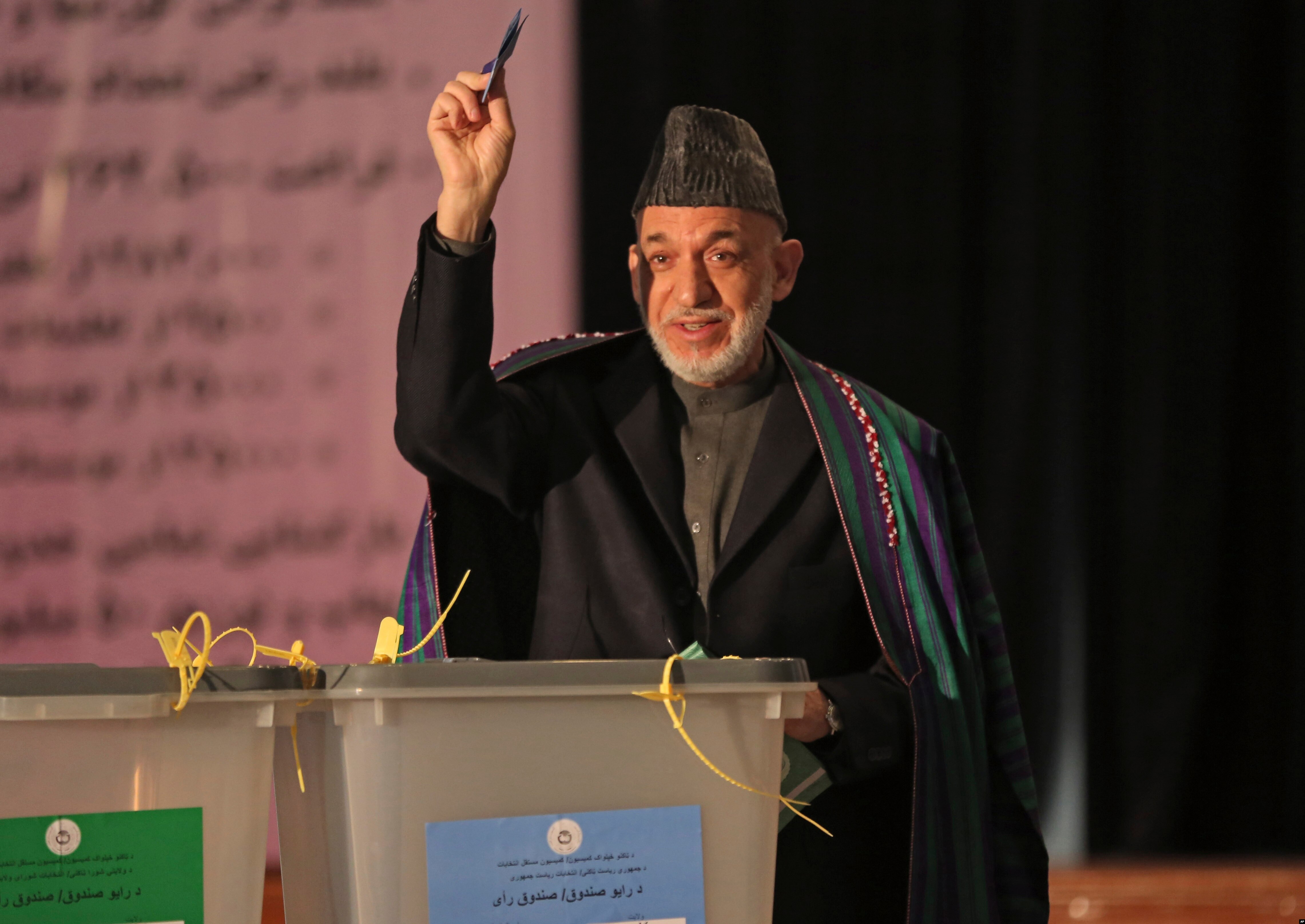
  • Afghan President Hamid Karzai shows his ballot paper to the media before he casts his vote at Amani high school, near presidential palace in Kabul, April 5, 2014.

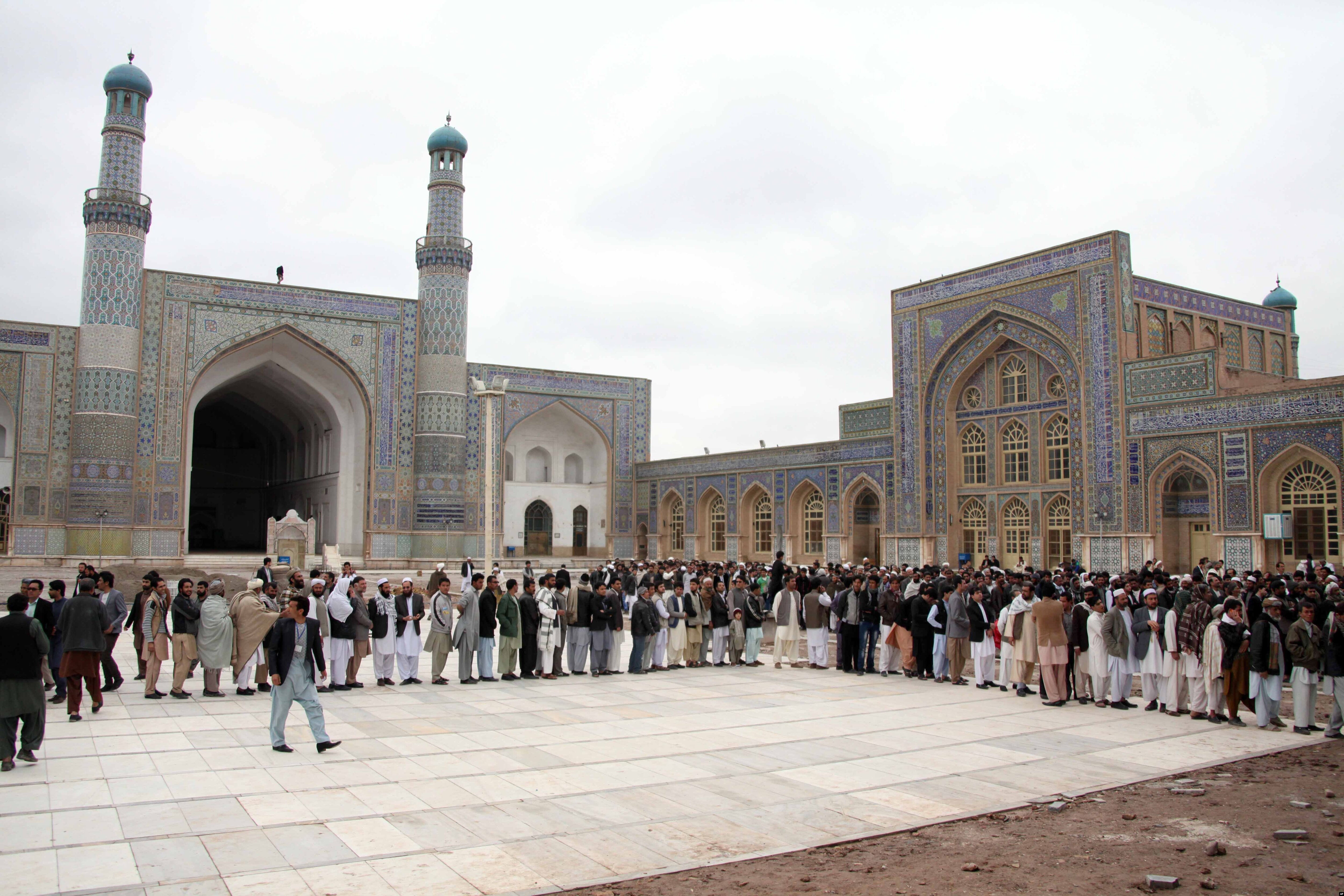
  • Afghan men line up before casting their votes in a polling station in Herat.

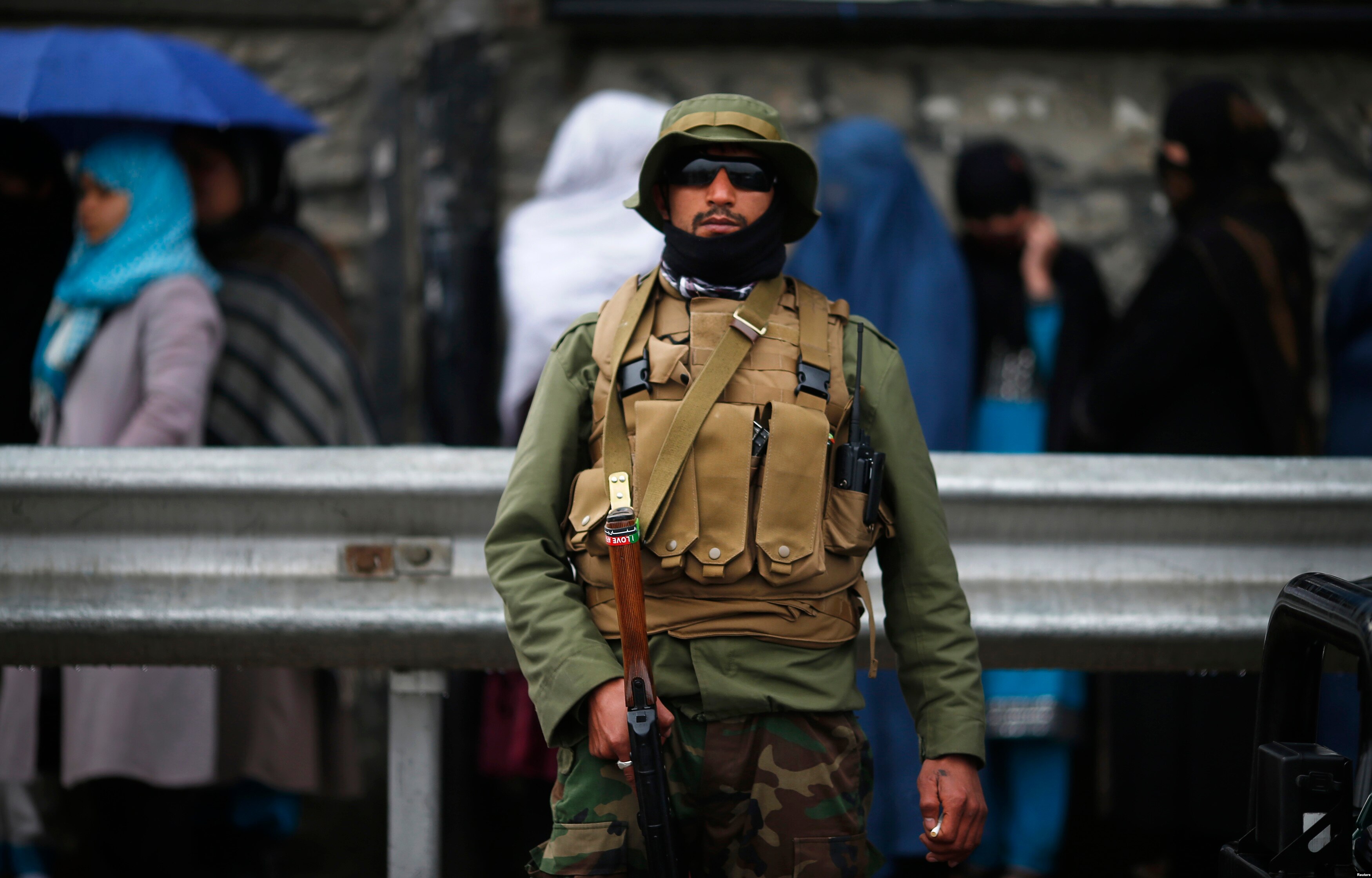
  • A policeman stands guard outside a polling station in Kabul as Afghans queue to vote outside before it opens.

  • An Afghan policeman searches men before they enter a polling station in Adraskan district, Herat province.

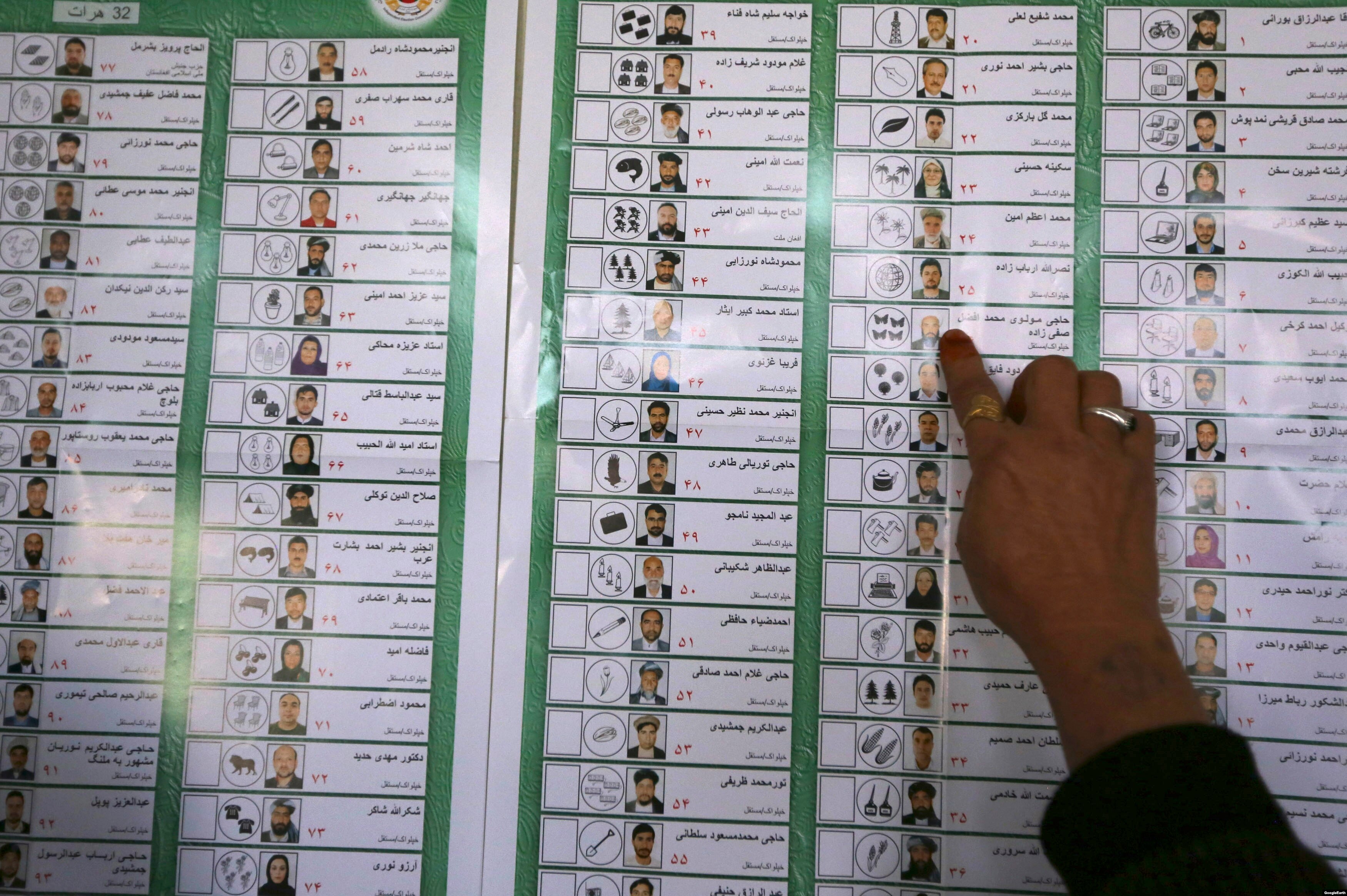
  • An Afghan woman looks for a candidate on a ballot while voting during presidential and provincial elections in Adraskan district, Herat province.

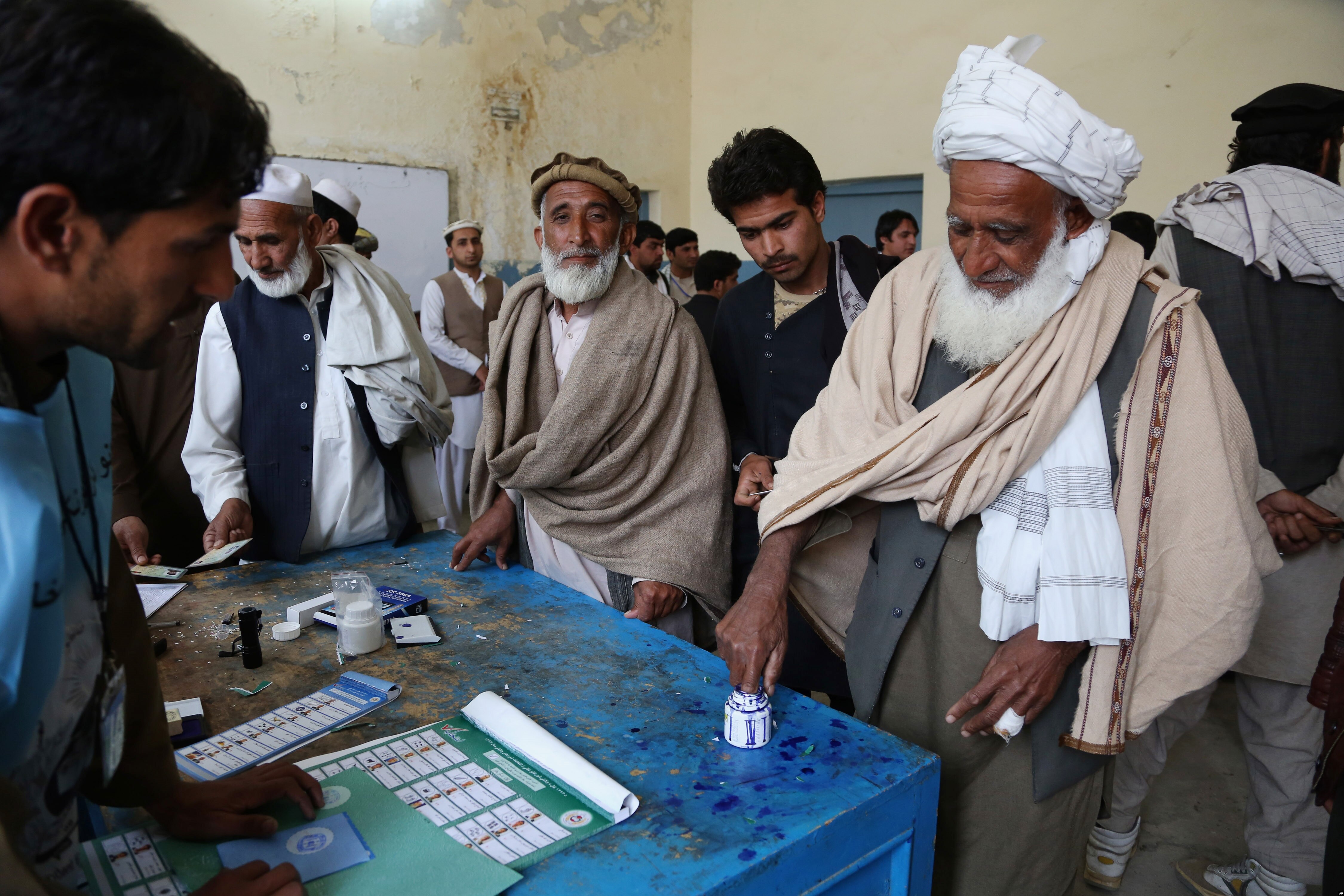
  • An Afghan man dips his finger into ink before casting a vote at a polling station in Jalalabad, east of Kabul.

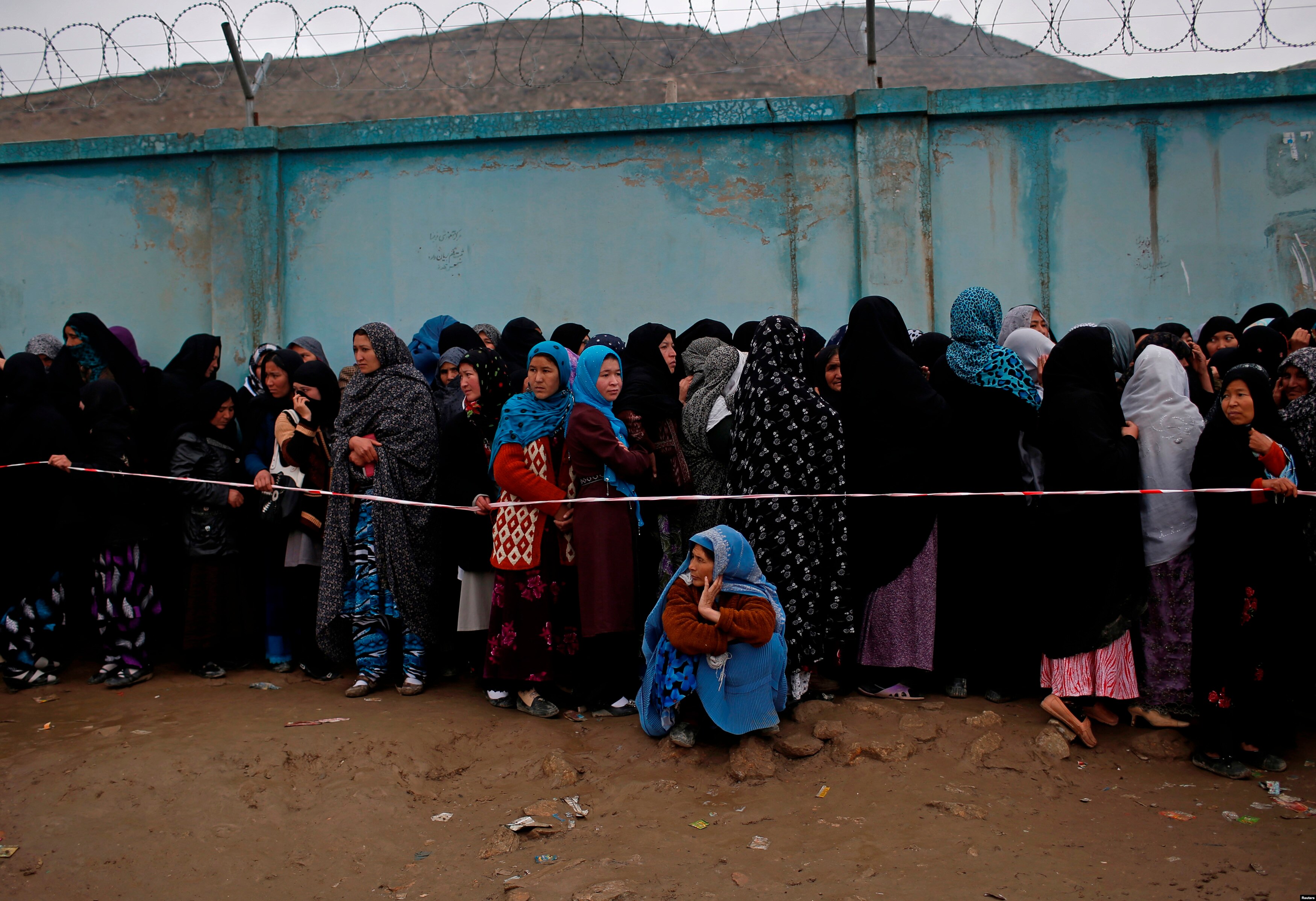
  • Women stand in line to vote at a polling station in Kabul.

  • An elderly woman shows another woman her inked finger after casting her ballot at a polling station in Kabul.

Voting in Kabul

Dressed in traditional blue burqas or more Western suits, hundreds of Afghans from all backgrounds crowded into polling stations to cast their ballots for a new president Saturday.
 
Braving Taliban threats and grey skies, voters filed past heavy security and were searched by military personnel before being allowed inside polling stations.
 
Once in, women and men entered different rooms to fill out large paper ballots, hopeful their votes will help bring peace and jobs to Afghanistan after years of war.
 
Haji Bibi, a 94-year-old woman almost bent double with age, was helped to a chair outside after having cast her ballot.
 
She says she is waiting for better things to come in life, and wishing for a peaceful life for the country, and that young and old people alike should vote for peace and security.

The Taliban claims it had carried out 246 attacks during the polling. The militant group often exaggerates.
 
Afghanistan deputy interior minister Gen. Ayub Slanagi said that by early afternoon, one suicide bomber had been arrested in Faryab province trying to enter a polling station, and two people were killed and five wounded in a bomb attack in eastern Logar province.  Earlier, one explosion in the eastern city of Jalalabad left no casualties and clashes in central Uruzgan province left one dead.
 
Good turnout

Turnout was reportedly good in most of the country, and in the former Taliban stronghold of Kandahar, turnout was particularly heavy, according to local media. Candidate Ashraf Ghani, one of the three front-runners in the presidential race, had held huge political rallies in the southern province, the site of years of heavy fighting against the Taliban.

The head of the Independent Election Commission, Ahmad Yusuf Nuristani, said Saturday turnout was surprisingly strong around the country. He said due to new security concerns, an additional 200 out of 6,400 polling stations had been closed, bringing the total number of closed voting sites to 900.
 
Ghani's closest rivals are Zalmai Rassoul, who also has a strong base in the south, and Abdullah Abdullah, who draws his support from different areas of the country.
 
Twenty-one-year-old voter Idriss said the elections are important for all Afghans.
 
"It is 10 years we are facing with bad problems in Afghanistan, in all sides of Kabul and other cities in Afghanistan, but we are, everybody is trying to vote for a president who would be great for Afghanistan and make a future that is better for them," he said.
 
Observers in place

Candidate-nominated observers, election officials and local independent monitors were standing watch inside the polling stations to prevent the widespread fraud that marred the last elections in 2009.

According to the Ministry of Interior, six people were arrested Saturday when they were caught cheating at the polls. Five others were detained in eastern Khost province when they were found carrying 1,000 fake IDs.
 
Ihmaduddin, an observer in a Kabul polling station, was determined to prevent any ballot rigging.
 
He says it's his job control and supervise the voting process to prevent fraud. He says he and others are also here to observe the counting of the ballots. He says we can observe and take pictures and report what we find to the Independent Election Commission and Complaints Commission.

Preliminary results are expected by April 24, but a final tally of the votes is only to be announced May 14. But analysts are already predicting a second-round runoff.

Kredit: www.nst.com.my

Jumaat, 4 April 2014

NST Online Top Stories - Google News

0 ulasan
Klik GAMBAR Dibawah Untuk Lebih Info
Sumber Asal Berita :-

NST Online Top Stories - Google News


Israel and Palestinians Look For Way Out of Talks Crisis - TIME

Posted: 04 Apr 2014 09:35 AM PDT

Private-sector employment reaches milestone in March - Los Angeles Times

Posted: 04 Apr 2014 09:35 AM PDT

WASHINGTON -- It took more than four years, but the economy last month finally recovered all the millions of private-sector jobs lost in the last downturn.

The March employment report released Friday showed employers added a reassuringly solid 192,000 jobs last month, shaking off the winter hiring doldrums. All of that came from private employers, bringing total nongovernment payrolls above the previous peak of 115.98 million in January 2008, near the start of the Great Recession.

"The private sector lost 8.8 million jobs during the labor market downturn and has gained 8.9 million since the employment low in February 2010," Erica L. Groshen, the commissioner of the Bureau of Labor Statistics, said in a statement accompanying the jobs report.

Still, that doesn't mean the labor market is back to where it once was. Far from it.

Apart from the unemployment rate, which remained at 6.7% last month, total government employment in March was more than 800,000 shy of its high in the spring of 2009. So it will most likely be a few more months before the economy recovers all the nonfarm jobs lost in the downturn.

Even then, it won't feel like a full recovery. That's because millions more new jobs were needed to keep up with the increase in the working-age population of the last few years. 

"We haven't really made up the losses," said Dean Baker, co-director of the Center for Economic and Policy Research. Baker estimates that the labor force, which is made up of those with jobs or who are looking for work, is 6 million larger today than at the start of the recession.

Then there's the mix of winners and losers. Construction employment in March remained more than 1.5 million short of its pre-recession level. Ditto for manufacturing. 

Those losses roughly equal the job gains in the last few years in two sectors: healthcare and social services, and restaurant and drinking establishments.

The shift helps explain the relatively higher unemployment for men, who dominate construction and manufacturing. And it also points to the downward pressure on average earnings.

Construction and manufacturing pay above the average hourly earnings for all private-sector workers, as does the health services category. But workers in restaurants and other leisure businesses make well below the average.

ALSO:

Betty Ford Center ready for a comeback

Americans are drinking less coffee daily, study says

U.S. lawmakers ask Gilead to justify hepatitis C drug's $84,000 price

Kredit: www.nst.com.my

Khamis, 3 April 2014

NST Online Top Stories - Google News

0 ulasan
Klik GAMBAR Dibawah Untuk Lebih Info
Sumber Asal Berita :-

NST Online Top Stories - Google News


Alleged shooter was not required to register weapon - USA TODAY

Posted: 03 Apr 2014 09:33 AM PDT

WASHINGTON — The suspected gunman in the Fort Hood shooting was not required to have his weapon registered with the military since he lived off post, Army Secretary John McHugh said Thursday.

Soldiers who bring weapons on to Fort Hood, though, are required to register those weapons as soon as they report to the post.

"He lived off post," McHugh said during testimony before a Senate committee. "We try to do everything we can to encourage soldiers to register their personal weapons, even when they live off post. We are not legally able to compel them to register weapons when they reside off post."

Soldiers who live in the barracks are required to keep their weapons in an armory, but those who live off post or in base housing can keep their weapons at home.

Barracks are dorm-like buildings that generally house junior enlisted soldiers. Noncommissioned officers and officers generally live in post housing or off post.

"The minute that soldier brought that weapon onto the post, it was not registered and it was, under our rules and regs, being utilized, obviously, illegally and with not proper clearance or foreknowledge by the command," McHugh said.

The latest Fort Hood policy on personal weapons was issued in a letter dated April 11, 2013.

Soldiers must also declare their personal weapon at the gate if they are coming to use the range or for some other reason, the policy says.

Base security personnel conduct random checks to ensure complaince, Col. Steve Warren, a Pentagon spokesman, said.

However, Warren acknowledged that on a post like Fort. Hood with 40,000 soldiers checking every vehicle is not practical.

Fort Hood could not immediately say how many personal weapons were registered with post authorities. But personal weapons are popular among military personnel. Some base exchanges sell handguns and rifles in the sporting goods department. It was not clear if that was the case at Fort Hood.

Soldiers are not allowed to carry concealed weapons on post, said Chris Haug, a Fort Hood spokesman.

At a hearing Sen. Lindsey Graham, R-S.C., asked about revisiting policy about prohibiting soldiers from carrying personal arms on U.S. bases, suggesting it might be helpful for self defense.

Gen. Raymond Odierno, the Army chief of staff, disagreed, saying military police carry weapons for law enforcement purposes and that was "appropriate."

Follow @jimmichaels on Twitter.

Contributing: Tom Vanden Brook

Supreme Court allows more private money in election campaigns - CNN

Posted: 03 Apr 2014 09:00 AM PDT

STORY HIGHLIGHTS
  • Supreme Court lifts limits on how much in total one person can donate
  • Its 5-4 ruling means wealthy donors can give to as many campaigns as they want
  • People can still only give a maximum of $5,200 to a single candidate
  • Critics warn the ruling further undermines already weakened campaign finance laws

Washington (CNN) -- If you're rich and want to give money to a lot of political campaigns, the Supreme Court ruled Wednesday that you can.

The 5-4 ruling eliminated limits on how much money people can donate in total in one election season.

However, the decision left intact the current $5,200 limit on how much an individual can give to any single candidate during a two-year election cycle. Until now, an individual donor could give up to $123,200 per cycle.

The ruling means a wealthy liberal or conservative donor can give as much money as desired to federal election candidates across the country, as long as no candidate receives more than the $5,200 cap.

While most people lack the money to make such a large total donation to election campaigns, the ruling clears the way for more private money to enter the system.

In effect, it expands the loosening of campaign finance laws that occurred with the high court's Citizens United decision in 2010 that eased campaign spending by outside groups.

Are campaign donations a form of free speech?

At issue was whether limits in the Federal Election Campaign Act on overall -- or aggregate -- campaign spending by individuals violate the First Amendment rights of contributors.

"We conclude that the aggregate limits on contributions do not further the only governmental interest this court accepted as legitimate" in a 1976 ruling, said Chief Justice John Roberts, who wrote the opinion of the court's conservative majority. "They instead intrude without justification on a citizen's ability to exercise the most fundamental First Amendment activities."

In dissent, Justice Stephen Breyer said the majority opinion will have the effect of creating "huge loopholes in the law; and that undermines, perhaps devastates, what remains of campaign finance reform."

Republican leaders hailed the decision as an affirmation of free expression rights.

"It does not permit one more dime to be given to an individual candidate or a party -- it just respects the constitutional rights of individuals to decide how many to support," said Senate GOP leader Mitch McConnell of Kentucky.

However, congressional supporters of tougher campaign finance laws expressed concern about more private money influencing elections.

"I am concerned that today's ruling may represent the latest step in an effort by a majority of the court to dismantle entirely the longstanding structure of campaign finance law erected to limit the undue influence of special interests on American politics," said Republican Sen. John McCain of Arizona, a longtime proponent of campaign finance reform.

New campaign finance reform?

Some legislators called for new campaign finance legislation in response to the ruling, but such reforms appeared impossible in an election year.

Sen. Pat Leahy of Vermont, the Democratic chairman of the Senate Judiciary Committee, said he would hold a hearing on the impact of "alarming Supreme Court decisions that have eviscerated our campaign finance laws."

Another top Senate Democrat, Charles Schumer of New York, warned of further erosion of limits on special interest influence in elections.

"This in itself is a small step, but another step on the road to ruination," Schumer said. "It could lead to interpretations of the law that would result in the end of any fairness in the political system as we know it."

The case involved Shaun McCutcheon, the owner of an Alabama electrical engineering company, with support from the Republican National Committee.

They objected to a 1970s Watergate-era law restricting someone from giving no more than $48,600 to federal candidates, and $74,600 to political action committees during a two-year election cycle, for a maximum of $123,200.

McCutcheon argued he had a constitutional right to donate more than that amount to as many office seekers as he wanted, as long as no single candidate got more than the $5,200 per election limit ($2,600 for a primary election and another $2,600 for a general election).

"Spending money on advertising, promoting ideas and supporting candidates is an exercise of our right to freedom of speech," McCutcheon told CNN on Wednesday after the ruling came out.

Preventing corruption

Supporters of the limits struck down Wednesday said the law prevented corruption or the appearance of corruption. Without the limits, they argued, one well-heeled donor could in theory contribute to every federal race possible.

The ruling leaves in place current donor limits to individual candidates, and donor disclosure requirements by candidates, political parties, and political action committees.

"What I think this means is that freedom of speech is being upheld," said House Speaker John Boehner, an Ohio Republican. "You all have the freedom to write what you want to write. Donors ought to have the freedom to give what they want to give."

But supporters of the limits expressed disappointment.

"The Supreme Court majority continued on its march to destroy the nation's campaign finance laws, which were enacted to prevent corruption and protect the integrity of our democracy," said Democracy 21 president Fred Wertheimer, a longtime advocate for election money reforms. "The court re-created the system of legalized bribery today that existed during the Watergate days."

Congress passed the individual aggregate limits in the wake of the Watergate scandal, and the Supreme Court upheld them in 1976.

The separate Citizens United case in 2010 dealt with campaign spending by outside groups seeking to influence federal elections.

In that case, the conservative majority -- citing free speech concerns -- eased longstanding restrictions on campaign spending by corporations, labor unions, and certain nonprofit advocacy groups.

The Citizens United ruling helped open the floodgates to massive corporate spending in the 2012 elections. It also led to further litigation seeking to loosen current restrictions on both spending and donations.

What the ruling on campaign money means

CNN Senior Congressional Producer Deirdre Walsh contributed to this report

Kredit: www.nst.com.my

Rabu, 2 April 2014

NST Online Top Stories - Google News

0 ulasan
Klik GAMBAR Dibawah Untuk Lebih Info
Sumber Asal Berita :-

NST Online Top Stories - Google News


Supreme Court Strikes Down Aggregate Campaign Contribution Limits - Wall Street Journal

Posted: 02 Apr 2014 08:51 AM PDT

WASHINGTON—The Supreme Court struck down caps on aggregate political contributions Wednesday, the latest in a string of decisions rolling back campaign finance regulations that the court's majority conservative justices believe infringe on First Amendment rights.

The 5-4 ruling threw out the limits, currently $123,200, on what any individual can give to federal candidates over a two-year election cycle. The plurality opinion, by...

Powerful earthquake strikes off Chile, triggers tsunami - CNN

Posted: 02 Apr 2014 08:37 AM PDT

Chilean President Michelle Bachelet speaks in Santiago on Wednesday, April 2, after a magnitude-8.2 earthquake struck off the coast of northern Chile. The quake triggered small landslides, prompted evacuations of coastal areas and generated a tsunami. At least six people were reported dead.Chilean President Michelle Bachelet speaks in Santiago on Wednesday, April 2, after a magnitude-8.2 earthquake struck off the coast of northern Chile. The quake triggered small landslides, prompted evacuations of coastal areas and generated a tsunami. At least six people were reported dead.
HIDE CAPTION
Earthquake off Chilean coast
Kredit: www.nst.com.my

Selasa, 1 April 2014

NST Online Top Stories - Google News

0 ulasan
Klik GAMBAR Dibawah Untuk Lebih Info
Sumber Asal Berita :-

NST Online Top Stories - Google News


Ryan Unveils House GOP Budget Claiming Balance - ABC News

Posted: 01 Apr 2014 08:52 AM PDT

House Budget Committee Chairman Paul Ryan unveiled an updated Republican budget plan Tuesday that would slash $5.1 trillion in federal spending over coming decade and promises to balance the government's books with wide-ranging cuts in programs like food stamps and government-paid health care for the poor and working class.

Ryan's plan would also cut Pell Grants for low-income students and pensions for federal workers, while steering away from cuts to benefits for senior citizens, at least in the short term. The proposal would reprise a voucher-like Medicare program for future retirees that would be the basis for GOP claims that the measure would drive down government debt over the long term. It also relies on unofficial scorekeeping help from the Congressional Budget Office, reflecting the beneficial effects of deficit cuts on long-term economic growth and tax revenues.

The plan should skate through the Budget Committee on Wednesday but faces challenges on the floor next week since it endorses a bipartisan pact — negotiated by Ryan and Senate Budget Committee Chairman Patty Murray, D-Wash., in December — to increase agency operating budgets this year and next.

Many conservatives who opposed the pact last year would have to reverse course and embrace them as part of the GOP budget. Democrats who helped pass the Ryan-Murray pact in December will oppose the GOP plan.

The legislation promises to serve more as a political and policy statement by House Republicans than a realistic attempt to engage President Barack Obama and Democrats, who control the Senate, in any serious effort to further cut the deficit. Election-year politics are in play, for starters, as are entrenched differences over spending and taxes.

At issue is the arcane congressional budget process, which employs a non-binding measure known as a budget resolution to set forth goals for future taxes, spending, and deficits. But follow-up legislation is usually limited to one-year appropriations bills rather than more difficult measure to deal with the government's long-term fiscal challenges, which are fueled by spiraling health care costs and the retirement of the baby boom generation.

Ryan's budget brings back a now-familiar list of spending cuts to promise balance, including $2.1 trillion over 10 years in health care subsidies and coverage under the Affordable Care Act, $732 billion in cuts to Medicaid and other health care programs, and almost $1 trillion in cuts to other benefit programs like food stamps, Pell Grants, and farm subsidies. While repealing the benefits of "Obamacare," Ryan would preserve its tax increases and cuts to providers, including cuts to private insurers under the Medicare Advantage program. Republicans have attacked Democrats for the Medicare cuts used to finance the new health care law.

"By cutting wasteful spending, strengthening key priorities, and laying the foundation for a stronger economy, we have shown the American people there's a better way forward," Ryan said in a statement.

As in the past, Ryan has steered clear of cuts to Social Security and promises steady increases for veterans. But he faced a more challenging task to promise to balance the budget by decade's end than he did last year because the CBO projects lagging revenue estimates.

Malaysian credibility in jet hunt questioned again after latest blunder - CBS News

Posted: 01 Apr 2014 09:18 AM PDT

Last Updated Apr 1, 2014 11:30 AM EDT

KUALA LUMPUR, Malaysia -- It may mean little to investigators that the last words air traffic controllers heard from the lost jetliner were "Good night, Malaysian three-seven-zero," rather than "All right, good night." But to Malaysian officials whose credibility has been questioned almost from the beginning, it means a great deal.

Malaysian officials said more than two weeks ago that "All right, good night," were the last words, and that the co-pilot uttered them. They changed the account late Monday and said they are still investigating who it was that spoke. The discrepancy added to the confusion and frustration families of the missing already felt more than three weeks after Malaysia Airlines Flight 370 disappeared, and as of Tuesday officials had not explained how they got it wrong.

"This sort of mistake hits at the heart of trust in their communications. If Malaysia is changing what the pilot said, people start thinking, 'What are they going to change next?" said Hamish McLean, an expert in risk and crisis communication at Griffith University in Brisbane, Australia.

"Information in a crisis is absolutely critical. When we are dealing with such a small amount of information its needs to be handled very carefully," he said.

Authorities have been forced on the defensive by the criticism, the most forceful of which has come from a group of Chinese relatives who accuse them of lying about - or even involvement in - the plane's disappearance. In part responding to domestic political criticism, defense minister Hishammuddin Hussein has taken to retweeting supportive comments on Twitter. He has twice in recent days proclaimed that "history would judge us well" over the handling of the crisis.

The government's opponents disagree. Opposition leader Lim Kit Siang said the correction set off a "medley of shame, sadness and anger" and strengthened the case for creating an opposition-led parliamentary committee to investigate the government's performance in the search.

The communications skills of any government or airline would have been severely tested by the search for the Boeing 777-200 and its 239 passengers and crew. So far not a scrap of debris has been found.

"There has been very little to tell and a lot of unanswered questions," said Andrew Herdman, director-general of the Association of Asia Pacific Airlines. "There is frustration on the lack of new information, frustration over progress with investigations and the search. That frustration is being channeled to the Malaysian authorities but I think it's a bit premature to use that to reflect adversely on how they are doing."

Still, the government's handling of information has at times fed perceptions that it was holding back. From the first day of the search, crews were looking far to the west of the plane's last point of contact with air-traffic controllers, but it took about a week for officials to explain that radar had detected the plane in the area.

"There are some things that I can tell you and some things that I can't," Malaysia's civil aviation chief said cryptically in the early days of the search.

"That was a terrible, terrible response," said Lyall Mercer, the principal of Australian-based Mercer PR, a public relations company. "It says to the families that 'we know things that we are not going to share' and that 'something else is more important than you'."

The piece of information that families most want to hear - whether their relatives are alive or dead - has remained impossible to say with finality, creating a dilemma for the government.

On March 24, it tried to address that. Malaysia Airlines officials met families in Kuala Lumpur and Beijing and sent a text message to others saying "we have to assume beyond any reasonable doubt that MH370 has been lost and that none of those on board survived."

At a news conference half an hour later, Prime Minister Najib Razak was less direct. He said with "deep sadness and regret" that the plane's last known position was "a remote location, far from any possible landing sites," and that the flight "ended" in the southern Indian Ocean.

Sarah Bacj, a 48-year-old American expatriate teacher whose boyfriend, Philip Wood, was on the flight, said the decision by Malaysia Airlines to inject some certainty into the fate of the passengers was a mistake. Until then, she said she thought the Malaysian government had acted responsibly, but the text message "totally violated my trust."

"I fell off the cliff," Bacj said. "The way the text message came, I expected proof. That they had found the bodies, or that they had found confirmed wreckage, or something ... but they didn't actually tell us anything at all. The only thing they did was make a judgment statement about evidence - unconfirmed evidence, mind you."

The final words from the cockpit, and who said them, are of interest not only because there are few other clues to the disappearance, but because the communication occurred just a minute before the plane's transponders were shut off. The words were in English, as aviation communications are around the world.

PR experts and professionals said the important thing now is to try and give the families as much information as possible, before the media gets hold of it, and to keep paying attention to them even when the media gaze had drifted.

On Tuesday, the Malaysian government announced that technical experts from Malaysia, China and Australia would brief the families in a closed-door session in Kuala Lumpur.

Meanwhile, the three-week hunt for Flight 370 has turned up no sign of the Boeing 777. The race to find debris from the plane before the black box stops sending out a "ping" signal ramped up this week, and the pressure is on.

flight-370-search-april1.jpg
Capt. Mark Matthews, head of the U.S. Navy's Salvage Operations, who is in Perth to help with the search, told CBS News' Holly Williams that if no confirmed debris from the jetliner is found before an American Towed Pinger Locator reaches the sprawling search zone, "we would be depending on luck."
If the black box pinger goes silent -- which should happen when the batteries die in one or two weeks -- Matthews said it will become "much more difficult to find, and much more time consuming to do those searches."

Australia said Tuesday that it would deploy a modified Boeing 737 to act as a flying air traffic control center over the Indian Ocean, to prevent a mid-air collision among the aircraft searching for the missing jetliner.

An air force E-7A Wedgetail equipped with advanced radar was to be deployed "in the near future" to monitor the increasingly crowded skies over the remote search zone, said Angus Houston, who heads the joint agency coordinating the multinational search effort.

At a news conference in Perth, Houston, the former Australian defense chief, called the search effort the most challenging one he has ever seen. The starting point for any search is the last known position of the vehicle or aircraft, he said.

"In this particular case, the last known position was a long, long way from where the aircraft appears to have gone," he said. "It's very complex, it's very demanding."

"What we really need now is to find debris, wreckage from the aircraft," he said. "This could drag on for a long time."

The search zone area has shifted as experts analyzed Flight 370's limited radar and satellite data, moving from the seas off Vietnam to the waters west of Malaysia and Indonesia, and then to several areas west of Australia. The current search zone is a remote 98,000 square mile that is a roughly 2 1/2 hour flight from Perth.


© 2014 CBS Interactive Inc. All Rights Reserved. This material may not be published, broadcast, rewritten, or redistributed. The Associated Press contributed to this report.

Kredit: www.nst.com.my
 

NST Online

Copyright 2010 All Rights Reserved