Bursa Malaysia opened lower Tuesday, weighed by weaker sentiment in regional equity markets.
At 9.11am, the FTSE Bursa Malaysia KLCI (FBM KLCI) was 14.7 points lower at 1,763.66, after opening 4.51 points easier at 1,773.85.
Japan's Nikkei 225 was 0.65 per cent lower at 13,668.06 and Hong Kong's Hang Seng Index fell 0.24 per cent to 22,463.70.
Nearer to home, Singapore's Straits Times Index shed 0.49 per cent to 3,157.75.
Facing external headwinds, Malaysian equities are set to come under renewed selling pressures today, said HwangDBS Vickers Research in a note today.
It said the FBM KLCI may pull back further from the
support-turned-resistance level of 1,785 with the next support line currently seen at 1,750.
"In particular, sentiment will likely be hit by an overnight drop on Wall Street," added HwangDBS.
Key US bellwethers slid between 0.4 per cent and 0.6 per cent last night amid continuous concerns of a monetary stimulus tapering .by the Federal Reserve anytime soon.
Index-linked stocks, Maybank and CIMB which contributed 4.3 per cent to the index, lost 16 sen to RM10.28 and 13 sen to RM7.77.
On the scoreboard, the Finance Index erased 151.89 points to 16,763.96, the Plantation index fell 52.64 points to 8,236.72 and the Industrial Index eased 24.22 points to 2,980.39.
The FBM Emas Index fell 82.41 points to 12,327.76, the FBM100 Index gave up 82.59 points to 12,050.32 and the FBM 70 Index shed 23.88 points to 14,225.46.
Losers outpaced gainers 212 to 67, with 158 counters unchanged, 1,148 untraded and 11 others were suspended.
Turnover totalled 167.208 million shares worth RM116.258 million.
Among actives, Daya Materials edged up half-a-sen to 36 sen, Luster Industries, China Stationery and Flonic Hi-Tec were flat at 10 sen, 25.5 sen and 20 sen, respectively.
Malaysian Airline slipped half-a-sen to 35.5 sen, Maxis was flat at RM7.20 but Axiata slipped five sen to RM6.85, Sime Darby declined three sen to RM9.46 and Petronas Chemicals eased two sen to RM6.60.-- Bernama
The ringgit opened lower against the US dollar in early trading today, in line with emerging currencies, a dealer said.
The ringgit fell against the US dollar to 3.2950/2980 from 3.2845/2875 yesterday.
The dealer said the strengthening of the greenback, boosted by high US Treasury yields, shifted investors appetite towards the US dollar.
"US benchmark bond yields hit a two-year high of nearly three per cent yesterday," he added.
The local currency was traded mostly lower against other major currencies.
It rose against the Singapore dollar to 2.5754/5782 from 2.5763/5798 yesterday but fell against the yen to 3.3729/3763 from 3.3629/3663 on Monday.
The ringgit was lower against the British pound at 5.1550/1610 from 5.1386/1440 yesterday and eased against the euro to 4.3939/3985 from 4.3769/3816 on Monday.-- Bernama
Hosni Mubarak, the former Egyptian president who was ousted from power in February 2011, could soon be released from detention after being cleared of corruption charges, according to his lawyer and judicial officials.
."All we have left is a simple administrative procedure that should take no more than 48 hours. He should be freed by the end of the week," Mubarak's lawyer Fareed El-Deeb told Reuters.
Judicial officials, speaking to the Associated Press on condition of anonymity because they were not authorized to talk to the media, said there were no longer any grounds to hold the 85-year-old former autocrat because of the expiration of a two-year legal limit for holding an individual in custody pending a final verdict.
Mubarak, 85, was cleared of corruption charges related to alleged embezzled funds for the presidential palace, but he is still to face a retrial over conspiracy to kill protesters during the violence that rampaged through Egypt in 2011.
Separately, The New York Times, citing state media, reported via Twitter that judicial authorities and security officials in the nation have ordered Mubarak's release.
The moves comes as clashes between Egypt's anti-military protesters and security forces, killing hundreds, have raged since Wednesday. At least 25 policemen were killed Monday when assailants ambushed two minibuses carrying security personnel in Egypt's north Sinai Peninsula.
(CBS News) WASHINGTON - The violence is taking place in Egypt. The aid debate is taking place at home. And on Sunday, there were new calls to reassess the American relationship with an increasingly fragile nation.
South Carolina Sen. Lindsey Graham believes Egypt is looking more and more like a failed state.
South Carolina Sen. Lindsey Graham is among those calling for the suspension of American aid to Egypt following deadly clashes in that country.
/ CBS News
"We're gonna have to suspend our aid, because we can't support the reaction of the military," he said on CBS' "Face the Nation" Sunday.
Historically the U.S. has been a major sponsor of the Egyptian military. Of the $1.5 billion in aid the U.S. sends Egypt yearly, $1.3 billion is for the country's security forces.
It was the military that ousted the elected president, Mohammed Morsi, and is shooting the president's supporters.
Middle East analyst Mohsin Khan said even if U.S. aid is suspended it will have little effect.
"Egypt needs something close to $15-$20 billion to get by," he said. "$1.3 billion is not that much. They are going to get a lot more from the Arab countries."
For decades, the U.S. has relied on Egypt's military to stabilize the Middle East. But the White House faces a dilemma -- preserving the relationship, but at what cost?
Of the $1.5 billion that goes from the U.S. to Egypt, $1.3 billion goes to the country's security forces. It was the military the ousted President Morsi.
/ CBS News
"We deplore violence against civilians," said President Obama on Thursday. He cancelled joint military exercises with Egypt and vowed more punitive action if the violence continues.
It is an approach Democratic Sen. Richard Blumenthal said he supports.
"Looking forward, I think that the approach has to be to condition our future aid on specific steps toward the rule of law and return to democracy," Blumenthal said.
But critics of the administration's strategy believe the White House's options are limited. Arizona Sen. John McCain said the Obama administration has lost credibility.
"We have to comply with the law," said McCain. "And this administration did not do that after threatening to do so."
Meanwhile, the president returns from his vacation Sunday evening. And increasingly there are concerns the lines of communication between Egypt's military leaders and U.S. officials are breaking down.
GIZA, Egypt — It looked more like a fortified military zone than a top tourist attraction that draws millions of visitors: Metal barricades, tan-colored tanks and men in army fatigues blocked the way to the Giza pyramids on Saturday.
"This is the street of the pyramids?" asked Sabr Agaya, who offers camel and carriage rides, in a rhetorical tone. "I can't believe this is the street. Sometimes my head spins."
Tourism in Egypt was devastated this week as museums and archaeological sites shut down and violence erupted, propelling looting and sinking the industry.
"My business died," said Agaya, standing among a pack of men with no work and a throng of emaciated horses. "No one comes."
Violence clawed through the country this week, killing more than 800 people since Wednesday, when security forces cleared two protest camps. At least 173 were killed in street battles that started during Friday protests and took place on major roads across the capital.
"We cannot accept any reservations until next Saturday," said Mohammed Sabry, who works in the reservations department at the Cairo Four Seasons, "because as you know, there are bad circumstances around the hotel."
Many reservations were canceled at the Mena House Hotel — built in 1869 as a hunting lodge for Egyptian royalty at the foot of the pyramids — said deputy hotel manager Ahmed Salem. He blamed the government-imposed nightly 7 p.m. to 6 a.m. curfew and the fact "there is no clear idea about what will happen in the next few days."
Last week, two major German tour operators canceled all trips to Egypt after the nation's foreign ministry warned Europeans against visiting popular beach resorts. Other European countries followed suit and on Thursday, the U.S. State Department renewed a warning urging Americans to avoid traveling to the country.
Security forces over the weekend protected the pyramids "not because the area is unsafe," Salem said. "It's a security measure: This is one of the most important places in Egypt."
Looters ransacked the Malawi Antiquities Museum overnight Thursday in Upper Egypt's city of Minya. Glass display cases were smashed and hundreds of artifacts were reported stolen. Others were left destroyed on the floor.
Antiquities Minister Mohamed Ibrahim said Saturday that no other archaeological sites were exposed to attacks and that security measures at museums and sites nationwide were boosted, state news agency MENA reported.
The fresh hit to the tourism industry began when millions rose up against former president Mohamed Morsi at the end of June. But the troubles date back even farther — to the 2011 uprising against Hosni Mubarak.
In 2011, the number of visitors to Egypt dropped by a third from previous year. The industry improved slightly in 2012 and saw an uptick of visitors in the beginning of 2013, according to official statistics, but was far from making a full recovery, particularly in Cairo.
The continuing downturn is devastating for many Egyptians who work as tour guides, sell souvenirs like papyrus and perfumes, or offer horse rides into the desert.
"I don't have money," said Mahmoud Al-Houry, 21, holding the reins of a horse and hoping tourists would come Saturday. "The horses don't eat."
The tourism situation is worse now than it was in 2011, said Martha Kjoell, a Norwegian volunteer who provides medicine and food for horses in Giza. "It's a disaster, really."
Most don't have job alternatives: Unemployment is up, the economy has been in steady decline and over the past two years there has been a halt in foreign and domestic investment.
"I have a lot of people who come to me and say, 'I can't feed my horse, please help me,' " Kjoell said.
HONG KONG — Bo Xilai, an ambitious and divisive Chinese politician whose downfall shook the Communist Party elite, will stand trial on Thursday on charges of corruption, taking bribes and abusing power, state-run news media announced on Sunday.
The brief report from the Xinhua news agency said Mr. Bo would be tried in Jinan, the capital of Shandong Province in eastern China. But the report gave no other details about the lurid allegations of corruption and a murder that toppled him and exposed bitter contention within the usually secretive Communist Party leadership.
Mr. Bo, 64, fell from power last year, upsetting preparations for a leadership transition and setting off reverberations still felt in Chinese politics. Accusations of skulduggery and graft around him and his family have drawn intense attention from Chinese people, and his trial is considered a test of how harshly and candidly the Communist Party elite deals with one of its own.
"Politics will determine how Bo Xilai is tried," said Chen Ziming, a commentator in Beijing who closely follows Communist Party affairs. "How much evidence they present will depend on how severely they want to punish him, not vice versa."
China's courts are controlled by the Communist Party, and there is little doubt that Mr. Bo will be found guilty after a carefully choreographed trial. His defense lawyer was appointed by the court. But experts have offered opposing views about the likely punishment. A death penalty appears very unlikely, but a prison sentence of 15 years or longer is almost certain, Mr. Chen said.
"The central leadership will have weighed up the various pressures — for Bo, against Bo — and come to a decision," he said. "It's not a decision for the court."
The political passions evoked by Mr. Bo have made his case a difficult one for the party leadership. If the evidence offered is flimsy or relatively slight, his supporters may accuse leaders of pursuing a political vendetta. But if the evidence is extensive and severe, others will ask why Mr. Bo was allowed to stay in power for so long, and even position himself for possible promotion into the central leadership.
An urbane former minister of commerce with a liking for sleek suits and media attention, Mr. Bo was appointed the Communist Party secretary of Chongqing, a relatively poor municipality in southwest China, in 2007. He turned Chongqing into a showcase for a blend of welfare programs, reverent propaganda for the revolutionary past and harsh measures against those suspected of being members of organized crime cartels. Mr. Bo was a member of the Politburo, an elite council with 25 members, and his supporters hoped that he would win a place in the Politburo Standing Committee, the innermost circle of party power.
But his critics claim that Mr. Bo's populist facade hid abuses of power and corrupt self-enrichment by him and his family. Mr. Bo fell abruptly from power in March last year, more than a month after the former police chief of Chongqing, Wang Lijun, fled to a United States Consulate. Mr. Wang disclosed accusations that Mr. Bo's wife, Gu Kailai, was involved in the murder of a British businessman, Neil Heywood, who knew the Bo family. And he accused Mr. Bo of trying to silence concerns about the case.
Ms. Gu was tried last August and found guilty of fatally poisoning Mr. Heywood in a hotel villa in Chongqing in November. She received a death sentence with a reprieve, meaning the sentence is likely to be reduced to a long prison term. Mr. Bo was expelled from the Communist Party in September, when the authorities began a formal criminal investigation.
"We still don't know what specific allegations lie behind the three charges against Bo Xilai," said Li Zhuang, a lawyer in Beijing who became one of Mr. Bo's fiercest critics after Mr. Li was jailed in Chongqing. Mr. Li had worked as a lawyer for a Chongqing businessman accused of running a criminal network.
"He could be accused of abusing power by trying to conceal or failing to report the Heywood murder," Mr. Li said in a telephone interview. "From what I've heard, the sums involved in the corruption case are not as much as in some other corruption cases, but I think Bo Xilai's damage to rule of law, private enterprise and justice was much worse than those other cases."
An associate of Mr. Bo's family said Ms. Gu's testimony would feature in the prosecution's case, although it was unclear whether she would appear at the trial or, as is often done in China, give written testimony. The associate, who spoke on the condition of anonymity to protect himself from official recrimination, said Ms. Gu might testify about, among other things, a villa in France that could form part of the corruption accusations. Phone calls to Mr. Bo's court-appointed lawyer, Li Guifang, were not immediately answered on Sunday night.
Mr. Bo has not been seen or heard in public since March last year, and it remains unclear whether he will contest the charges. But the government is taking no chances by holding the trial in Jinan, a city about 810 miles from Chongqing, where many residents still think fondly of Mr. Bo.
Another complication is that Mr. Bo is a "princeling" — the son of a revered revolutionary who served alongside Mao Zedong — and had personal ties with many other princelings, including Xi Jinping, who was appointed Communist Party chief in November. Since coming to office, Mr. Xi has promised to clean out corruption and waste in the party, and to remove crooked officials.
A Chinese businessman who is friends with other princelings said some of them had continued to express misgivings that Mr. Bo was being treated too harshly, even if he deserved censure for his mistakes. He spoke on the condition of anonymity to preserve his friendships with party insiders.
— Gunfire broke out Saturday as Egyptian security forces tried to get Muslim Brotherhood partisans to leave a mosque where they took refuge overnight.
Government forces surrounded the mosque as small clusters of people left from time to time. The Interior Ministry says more than a thousand people were detained overnight across the country, and that Friday's death toll stands at 173.
Gunshots rang out, at times heavily, as security forces fired on the minaret of the al-Fatah Mosque, where Brotherhood supporters have been holed up since Friday. Earlier, scuffles broke out between police and army troops ringing the main entrance.
Elizabeth Arrott reports from Cairo
Al Jazeera Television, which tends to support the Brotherhood, showed images of a cluster of veiled women trying to stop police from approaching the building. The TV's reports in Arabic urged Egyptians to come to the mosque to "defend those inside" - believed to include several top Brotherhood leaders.
Arab media reported that a son of the group's spiritual leader, Mohamed Badie, was killed in clashes near the mosque Friday. Al-Ahram Online reported that Islamist Mohamed Zawahiri, brother of al-Qaida leader Ayman Zawahiri, was arrested by police Saturday.
Egypt's interim prime minister, Hazem le-Beblawi, said the new government will work "until its last breath" to find a democratic solution to the crisis - but not with those who use violence:
He says, "Our job is to move to a democratic system with a consensual constitution, with free elections. But there can be no reconciliation with those who have fired on the state."
A spokesman for Egypt's interim government told reporters Saturday that a handful of foreigners, including Syrians, Pakistanis and a Palestinian, were arrested, and quantities of ammunition, molotov cocktails and assorted weapons were confiscated.
The spokesman insisted that the government would continue to "use an iron fist against acts of violence," and said that violence included attacks on 12 churches, two prisons, numerous shops, the Finance Ministry, the library in Alexandria and various government buildings.
He says he cannot call what took place a "peaceful protest," but that police are trying to use maximum restraint and negotiate with protesters, to avoid bloodshed.
Muslim Brotherhood officials say they are planning more protests later Saturday, but gave no details. The Islamist group said earlier that its "Friday of Rage" protests will continue for a full week.
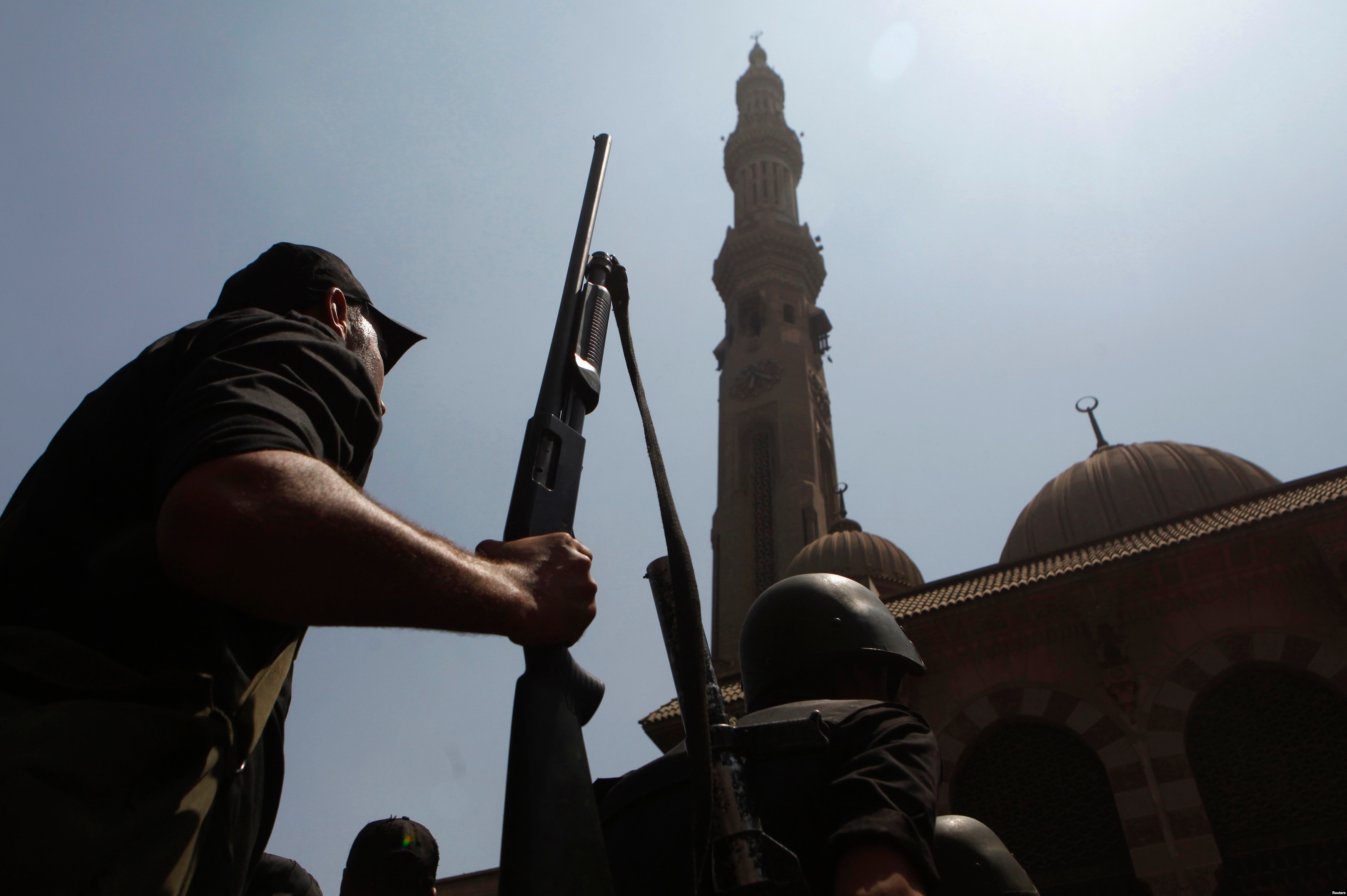
Armed Egyptian policeman moves into position in front of al-Fath mosque on Ramses Square in Cairo, August 17, 2013.
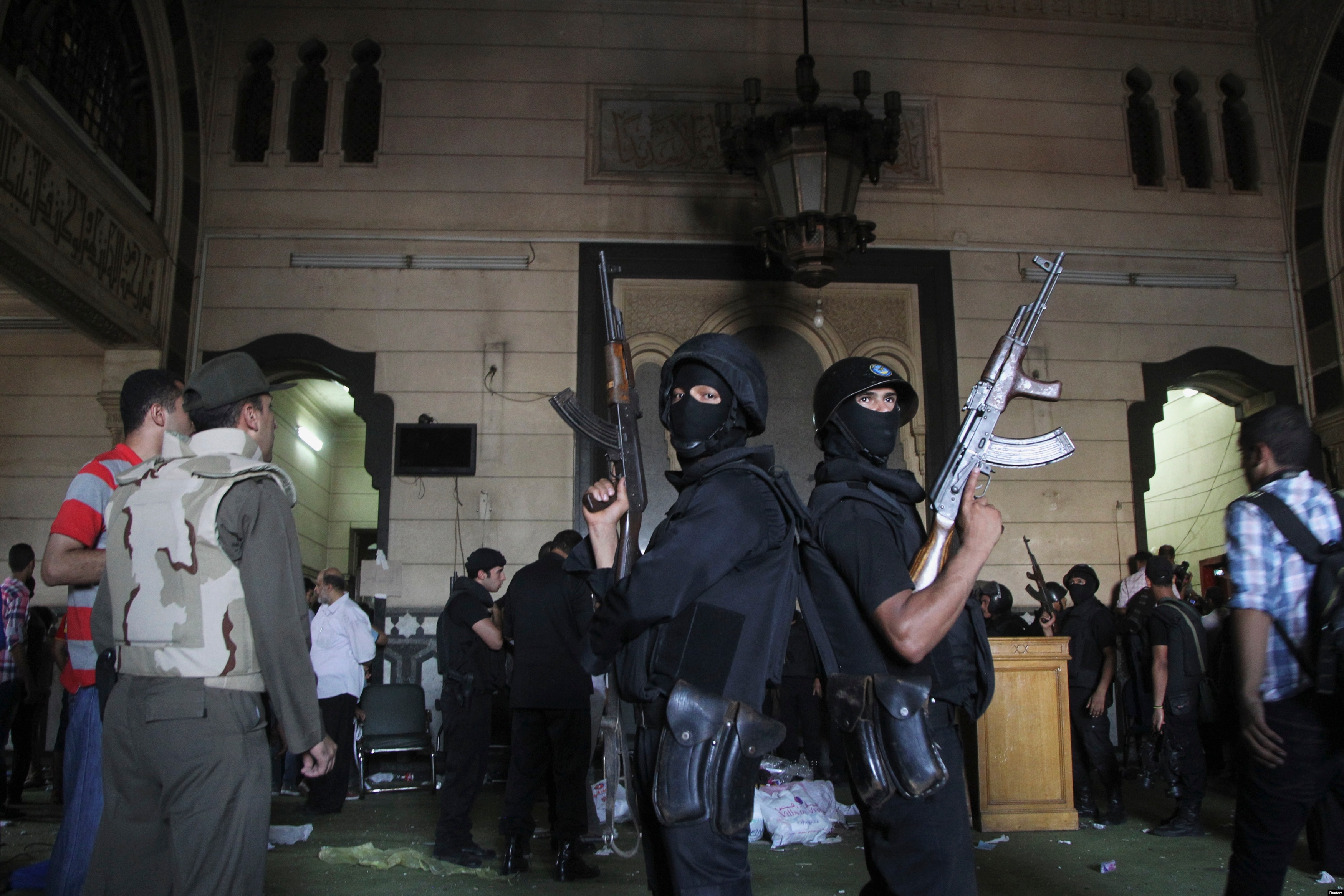
Policemen stand guard inside a room of the al-Fath mosque when supporters of deposed Egyptian President Mohamed Morsi exchanged gunfire with security forces inside the mosque in Cairo, Aug.t 17, 2013
Anti-Mursi protesters and riot police officers gather outside al-Fath mosque at Ramses Square in Cairo, August 17, 2013.
A police officer takes position during clashes with supporters of deposed Egyptian President Mohamed Morsi inside a room of al-Fath mosque in Cairo, August 17, 2013.
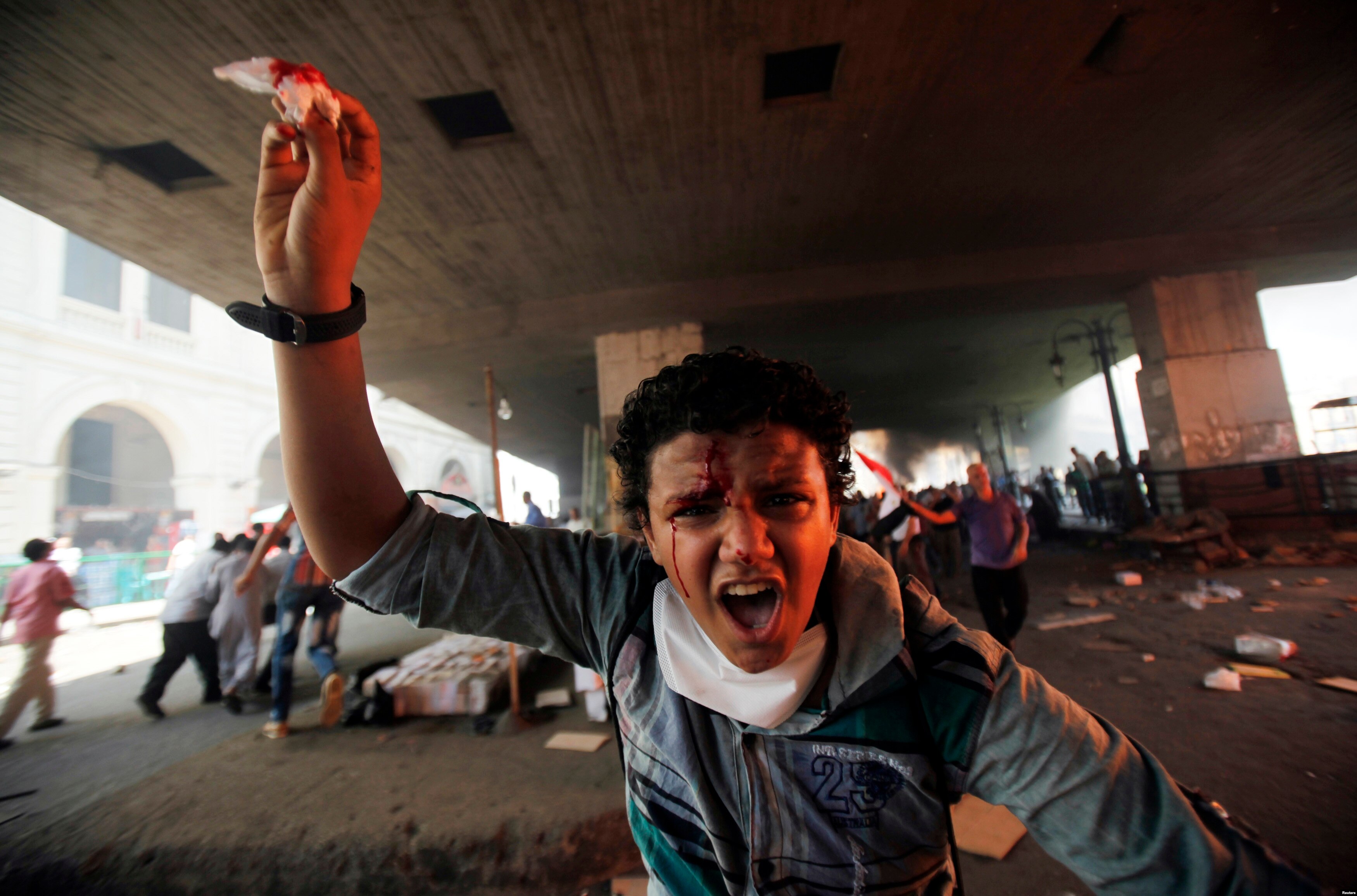
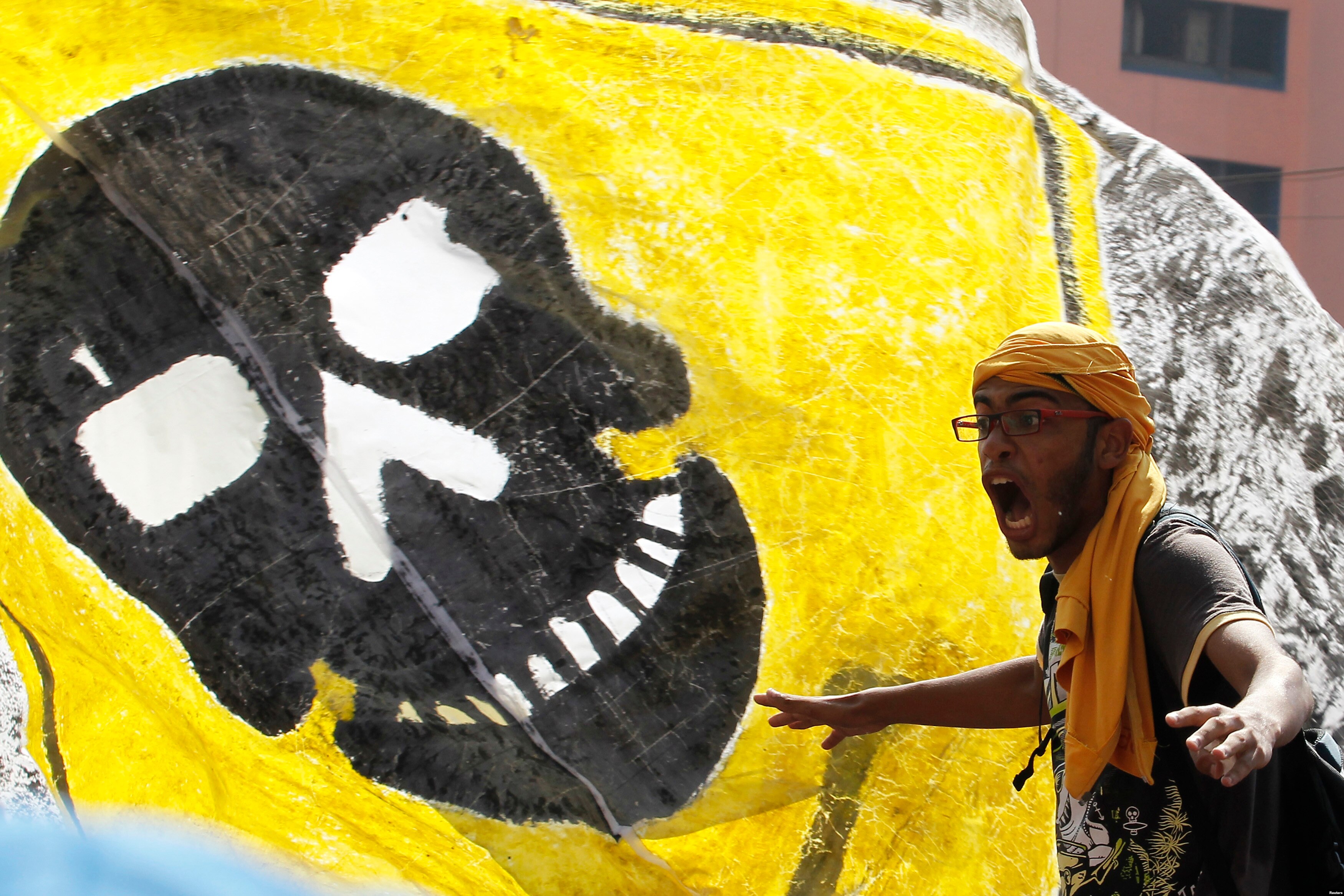
A member of the Muslim Brotherhood and supporter of ousted Egyptian President Mohamed Morsi shouts slogans after he is injured in front Azbkya police station during clashes at Ramses Square, Cairo, August 16, 2013.
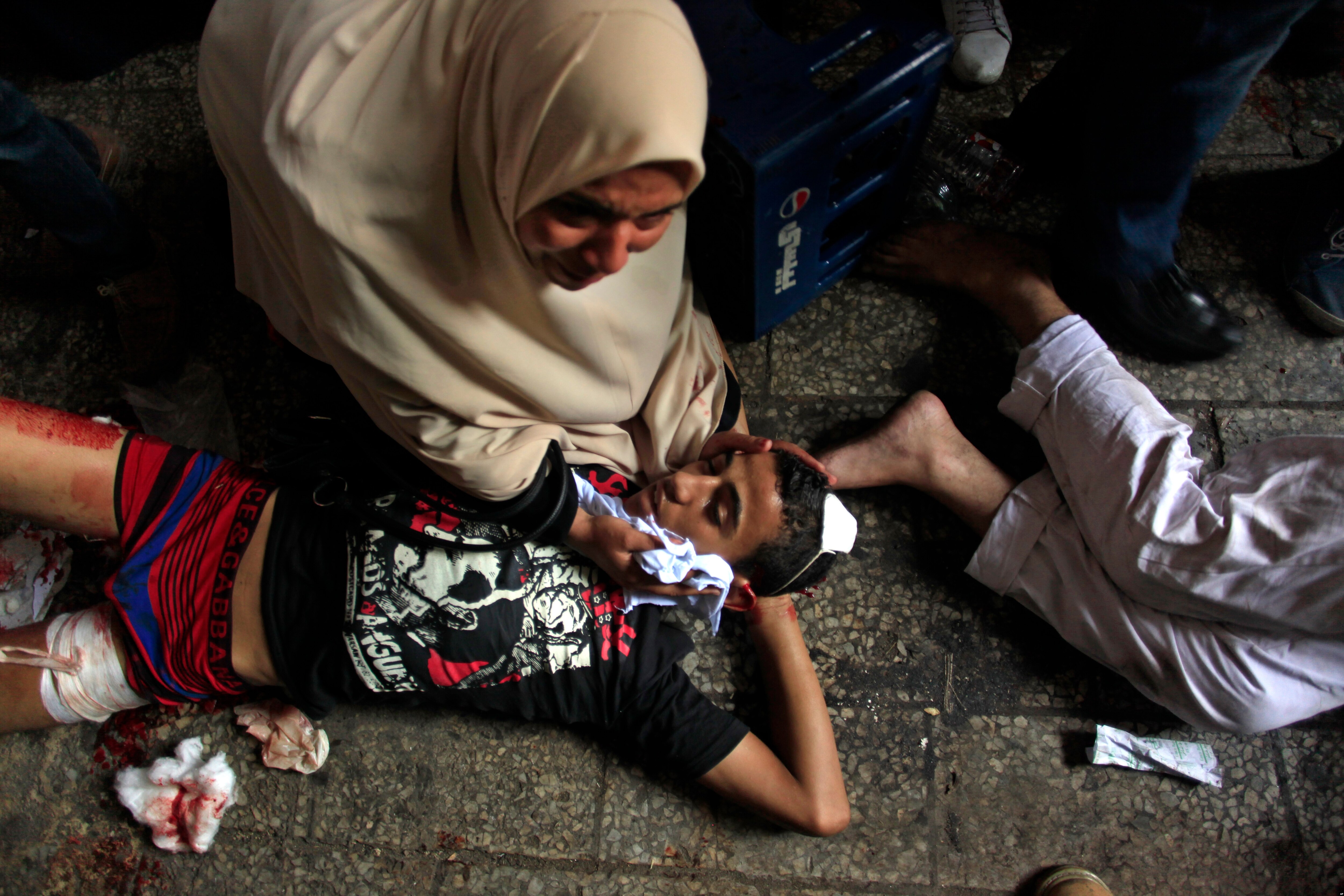
Egyptians lay on the ground after being injured during clashes between security forces and supporters of Egypt's ousted President Mohamed Morsi in Ramses Square, Cairo, August 16, 2013.
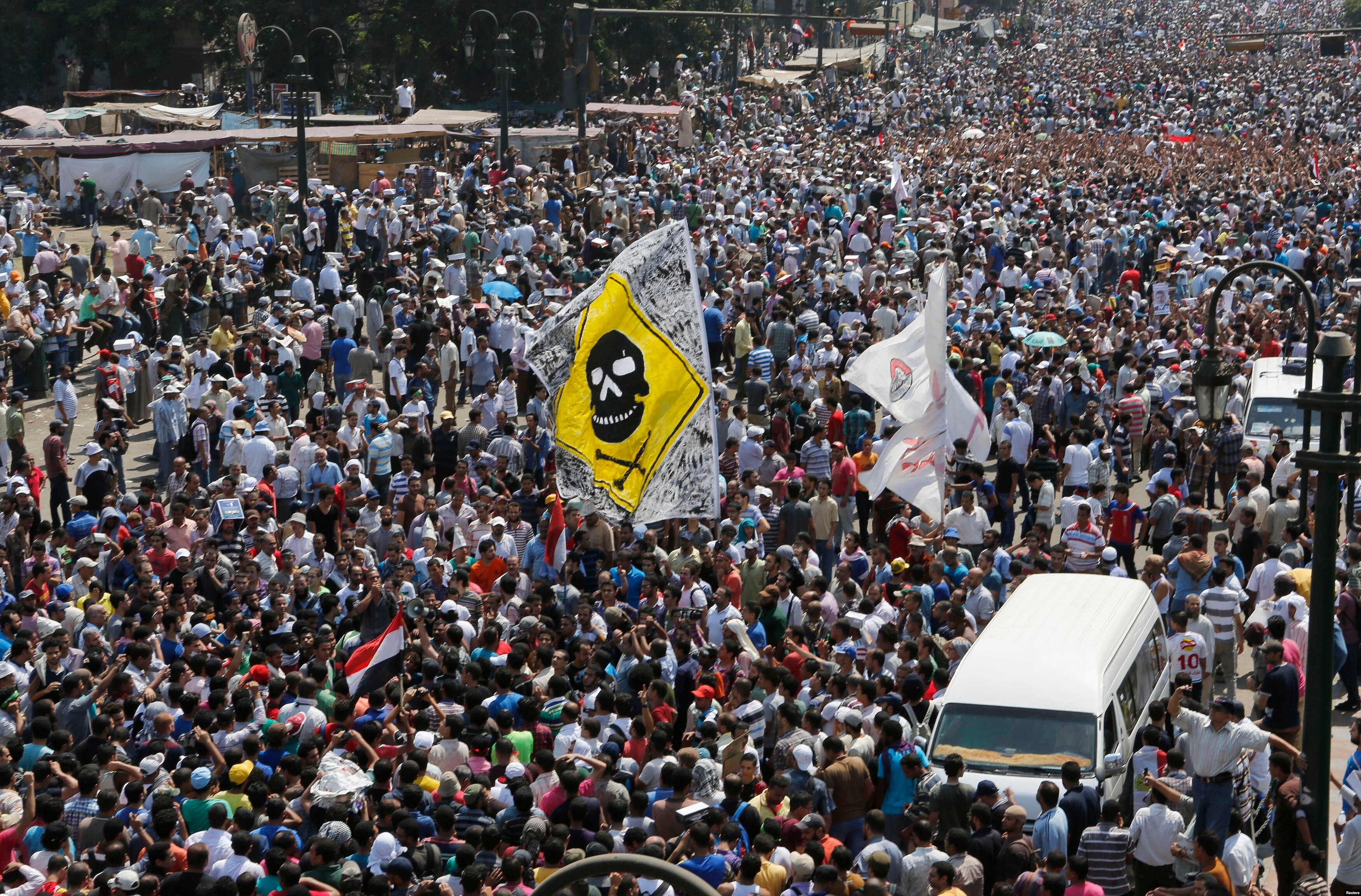
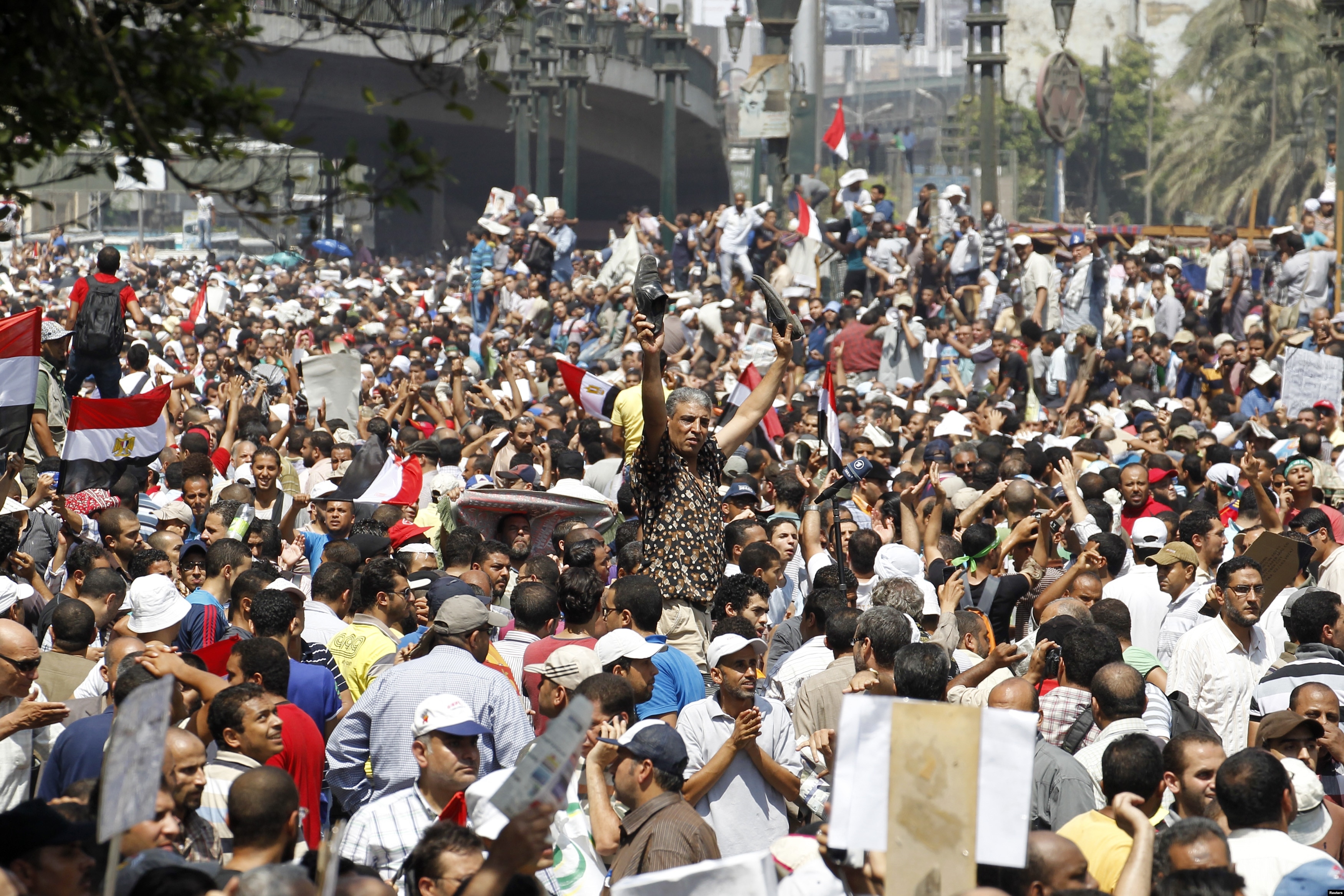
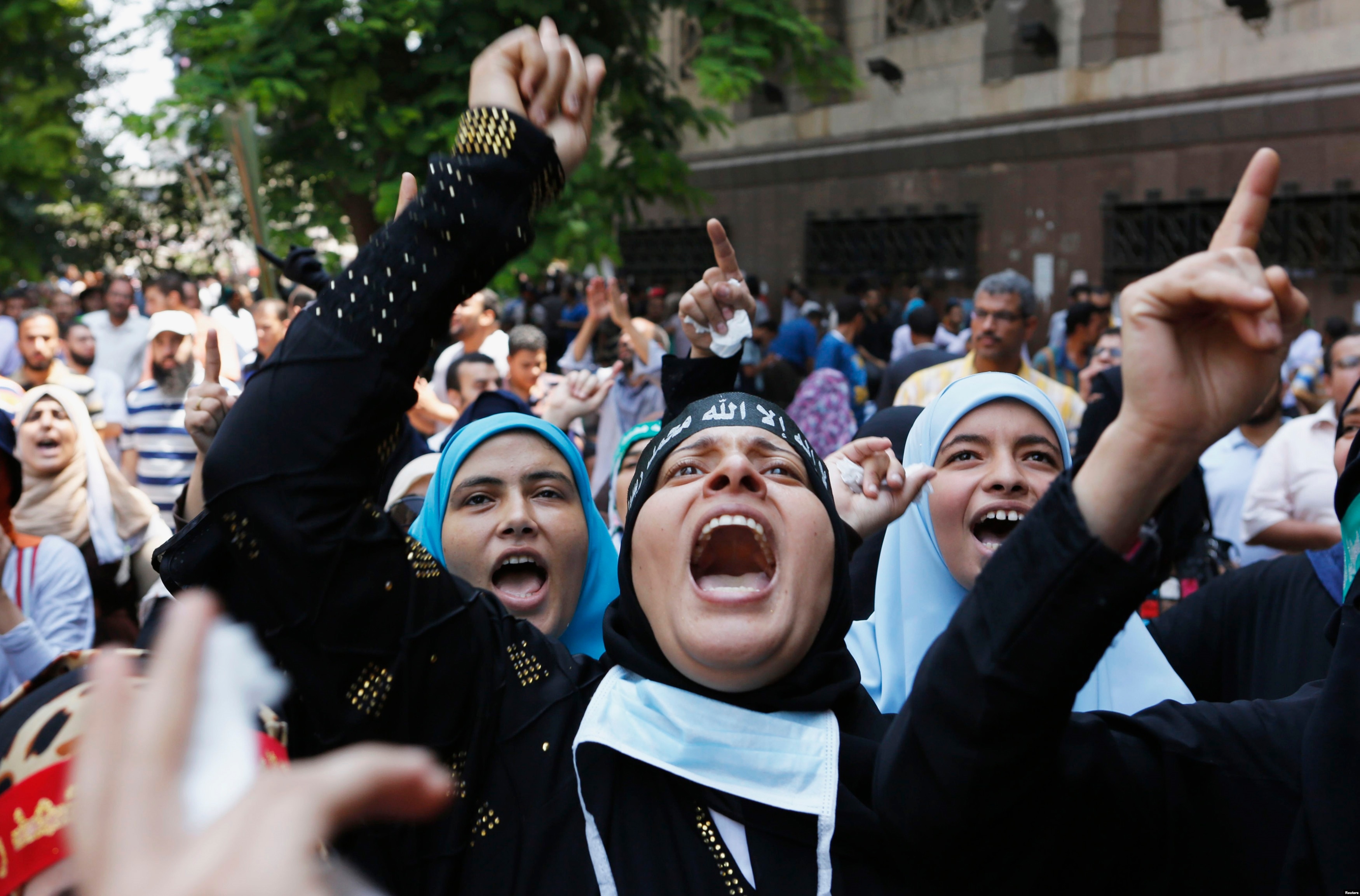
Supporters of ousted Egyptian President Mohamed Morsi gather in Cairo, August 16, 2013.
A supporter of deposed Egyptian President Mohamed Morsi shouts slogans during a protest outside Al-Fath Mosque in Ramses Square, Cairo, August 16, 2013.
Supporters of deposed Egyptian President Mohamed Morsi shout slogans and wave Egyptian flags during a protest outside Al-Fath Mosque in Ramses Square, in Cairo, August 16, 2013.
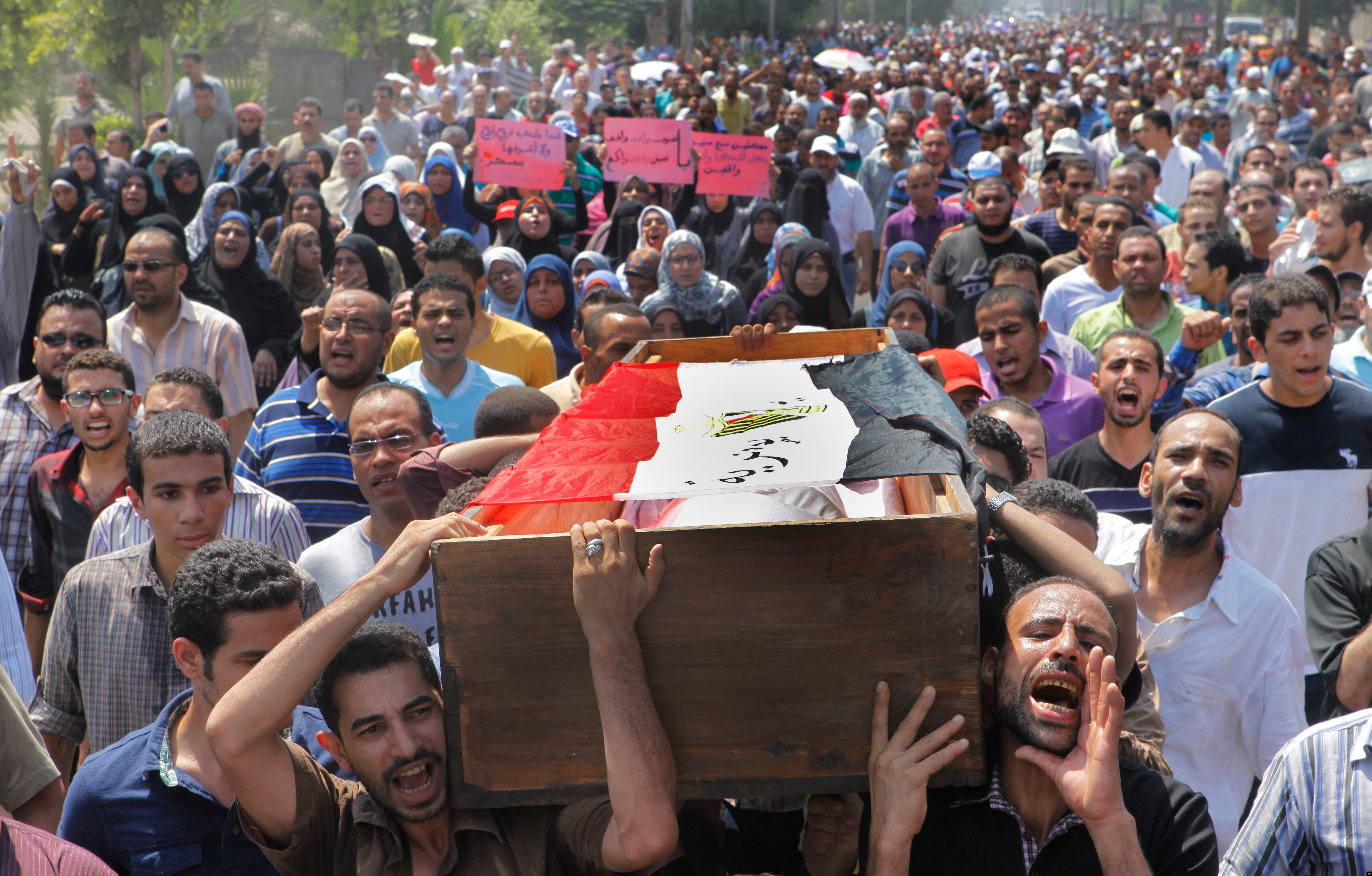
Supporters of Egypt's ousted President Mohamed Morsi carry a coffin, covered with a national flag, of a protester who was killed during Wednesday' clashes in Cairo, August 16, 2013.
Supporters of deposed Egyptian President Mohamed Morsi take part in a protest near Ennour Mosque, Cairo, August 16, 2013.
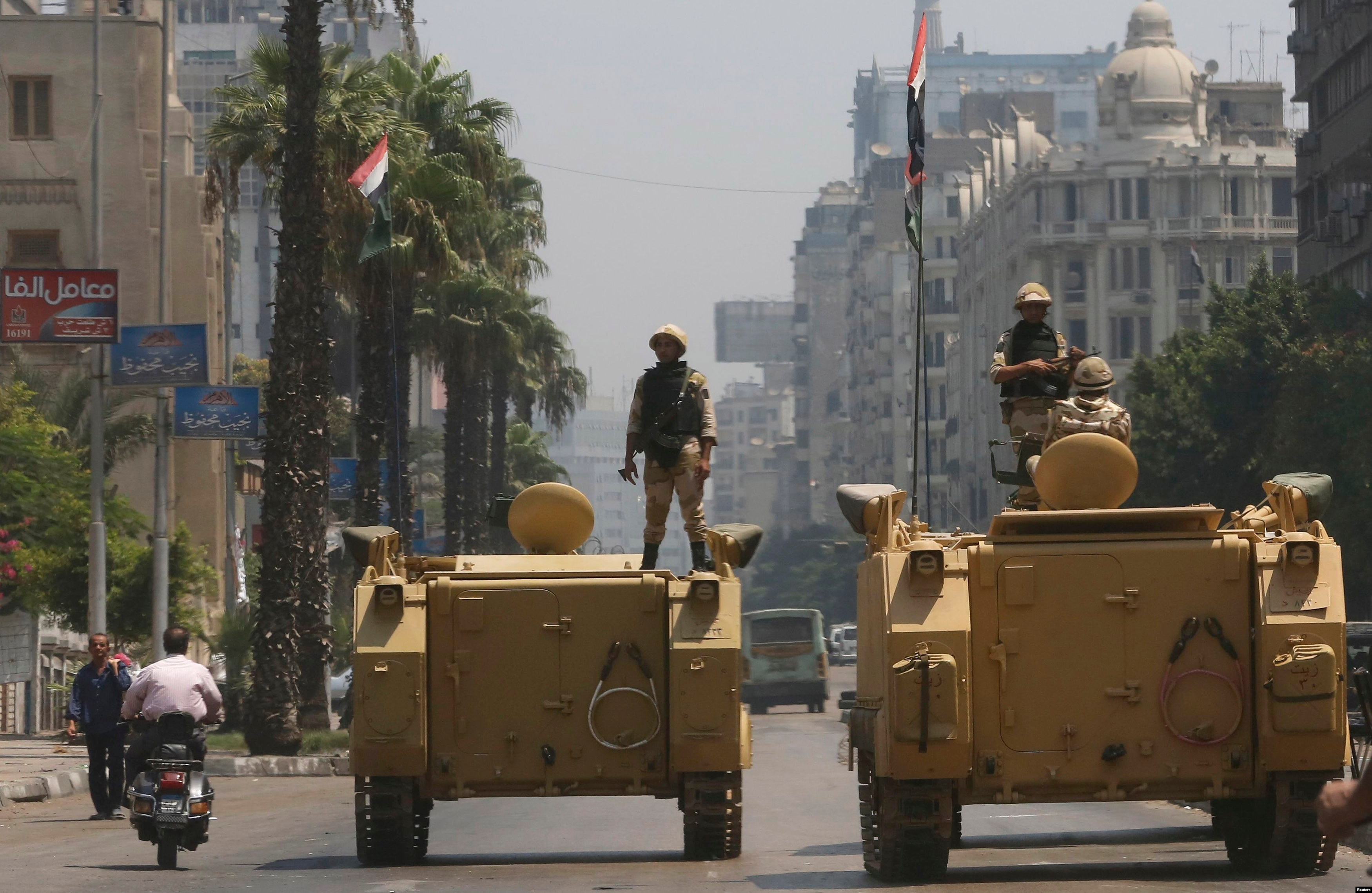
A soldier holds his weapon as he stands on an armored personnel carrier positioned outside the state-run television station in Cairo, August 16, 2013.
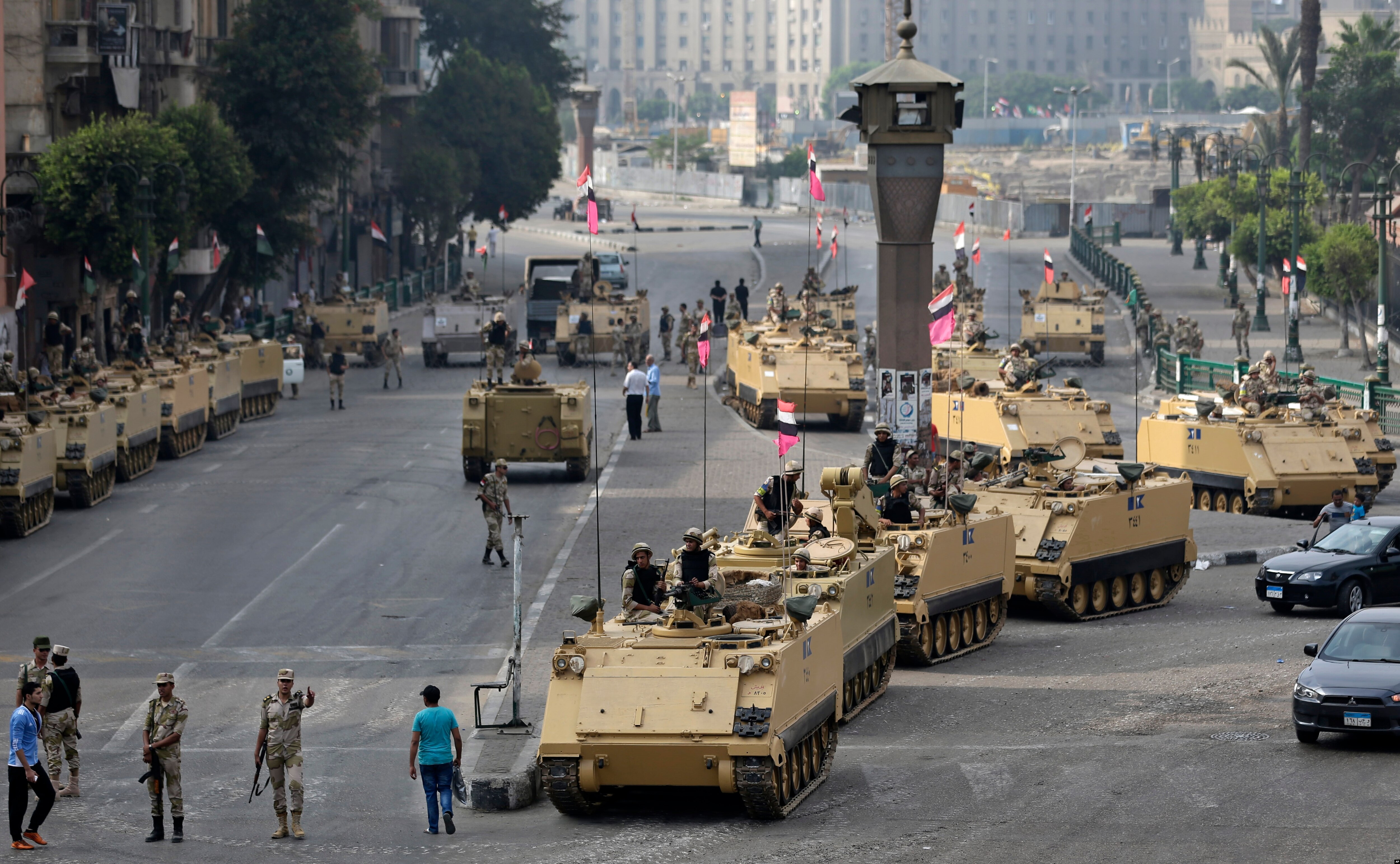
Egyptian army soldiers take their positions at an entrance to Tahrir Square, Cairo, August 16, 2013.
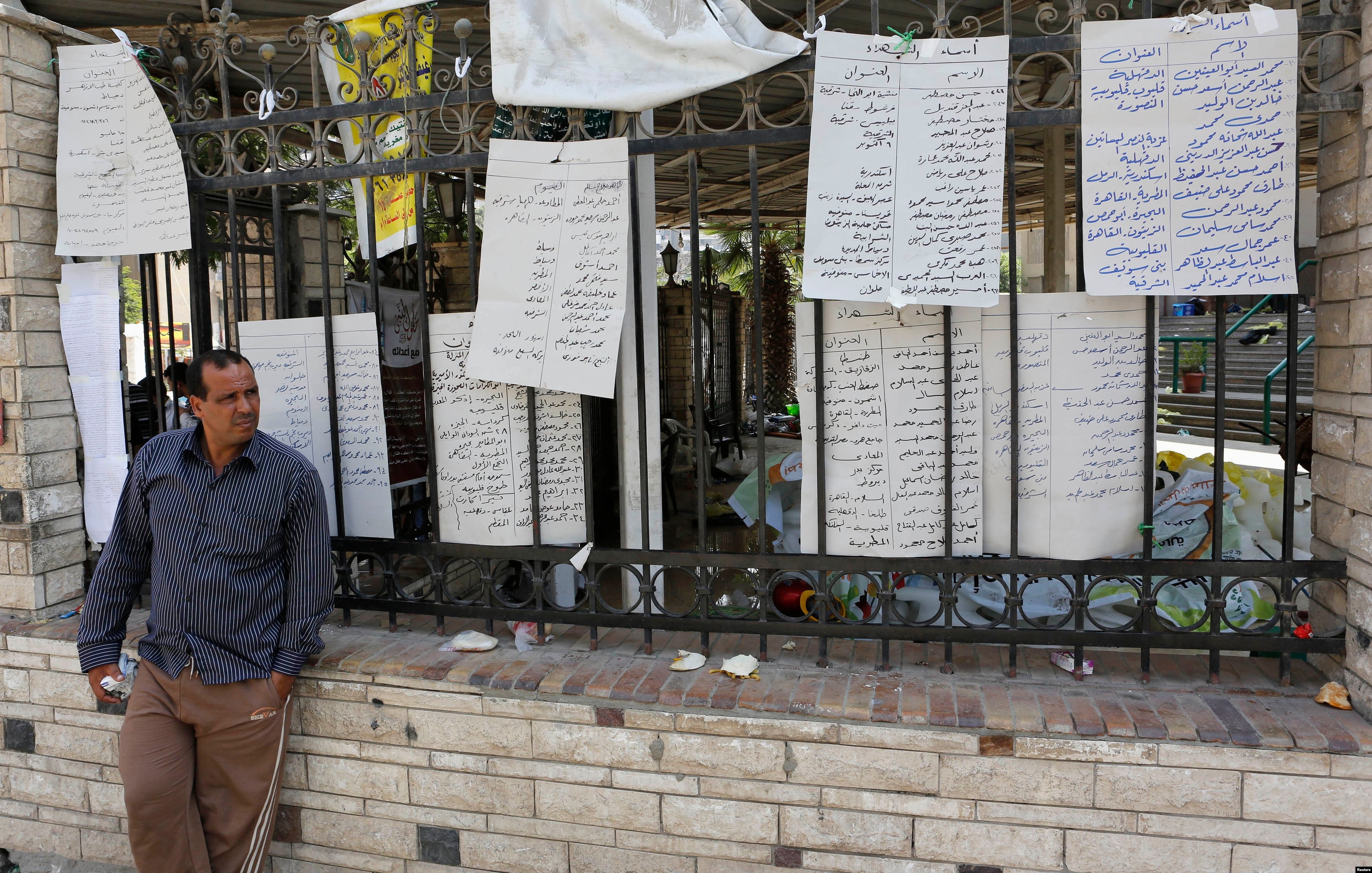
A man who lost relatives in recent violence stands near a list of names of dead members of the Muslim Brotherhood and supporters of deposed Egyptian President Mohamed Morsi at El Eyman mosque in Cairo, August 16, 2013.
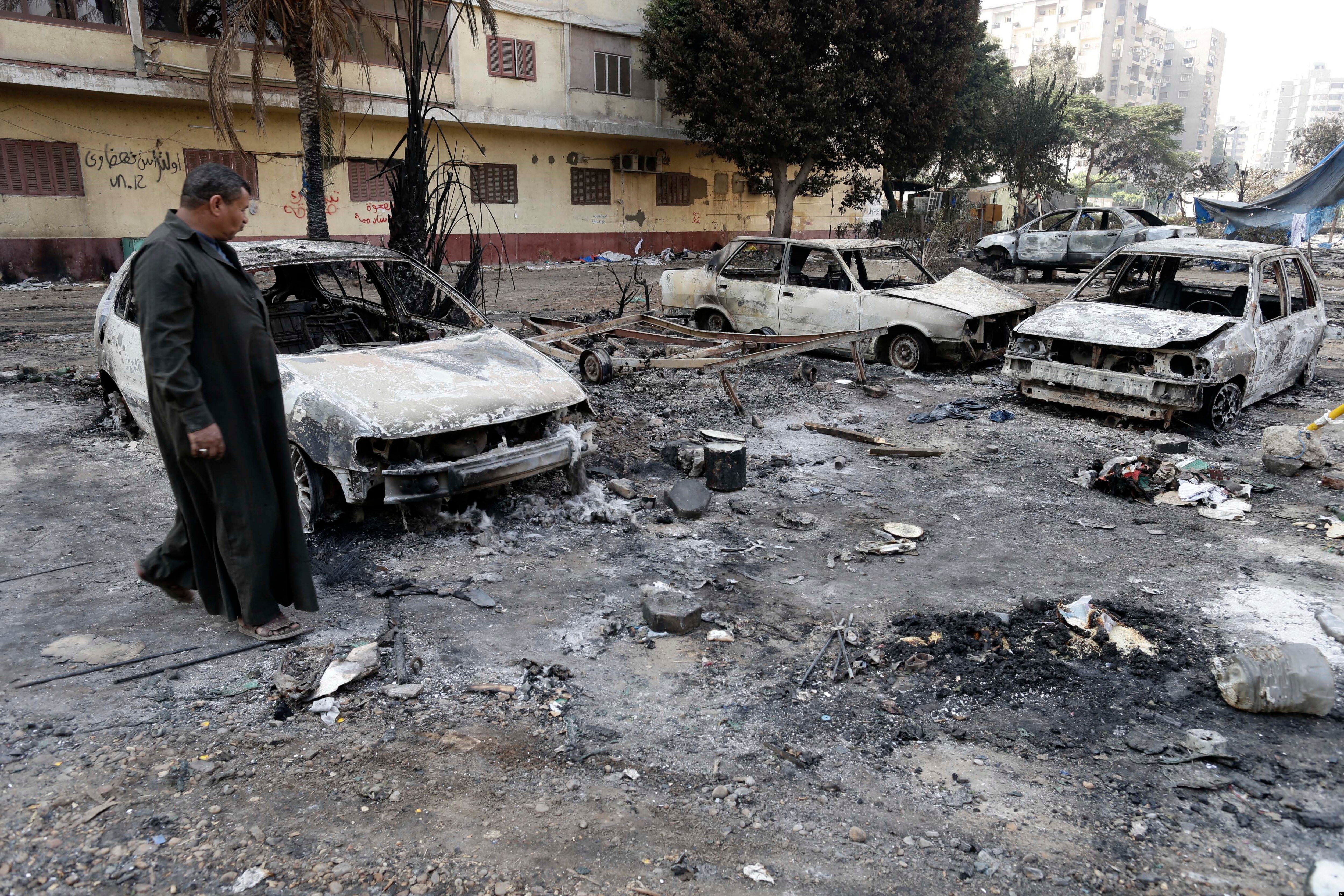
A man walks through debris from what is left of burned vehicles outside the Rabaah al-Adawiya mosque, Cairo, August 16, 2013.
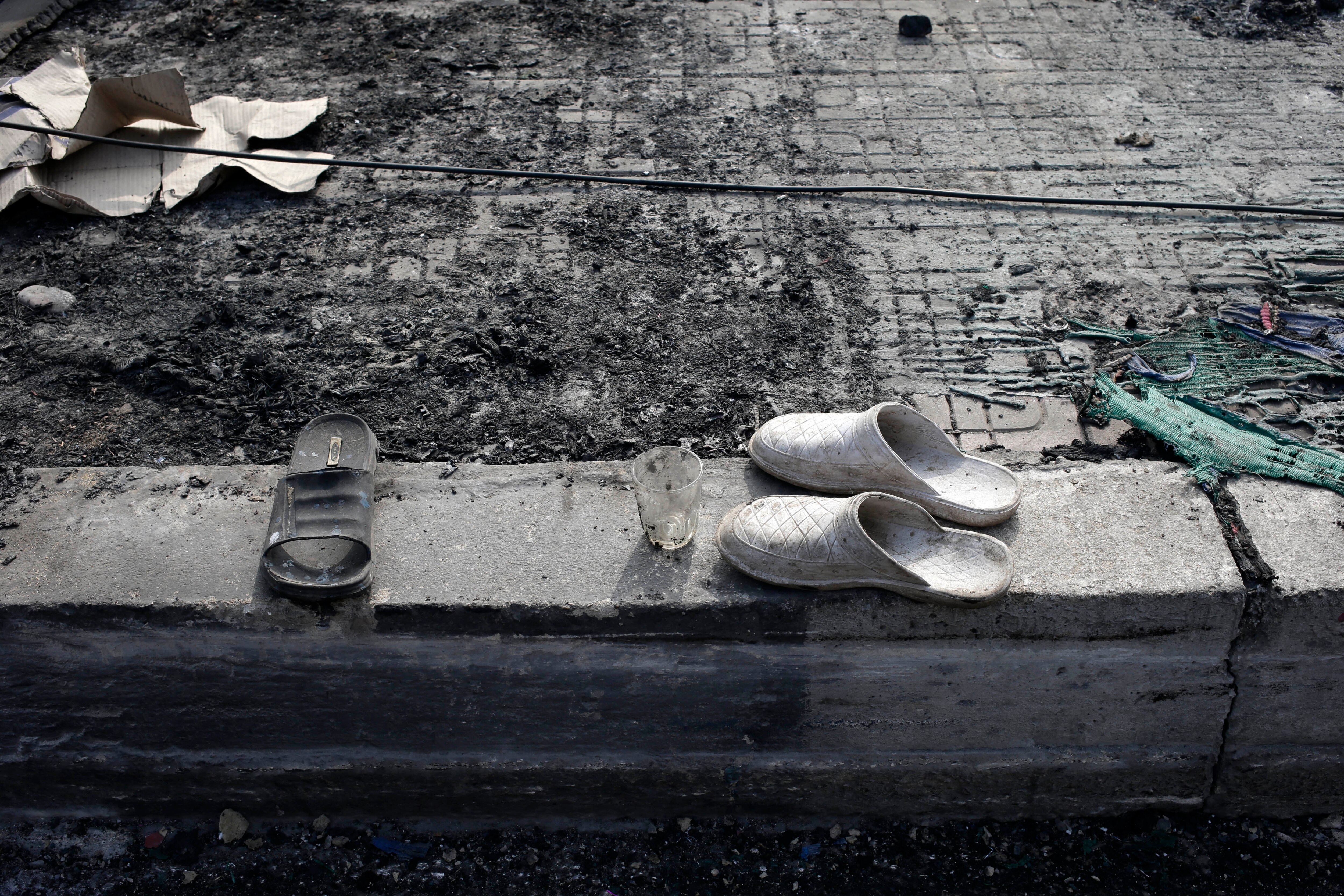
Abandoned shoes and a tea glass, belonging to supporters of ousted Egyptian President Mohamed Morsi, remain on a wall outside the Rabaah al-Adawiya mosque, Cairo, August 16, 2013.
Since the public learned in June about sweeping National Security Agency programs, government officials from President Obama on down have insisted the nation's surveillance programs are subject to layers of oversight.
"I am comfortable that the program currently is not being abused," Mr. Obama said in a press conference last week, when he announced new efforts at increasing transparency. "Part of the reason they're not abused is because these checks are in place."
However, the latest revelation that the NSA violated privacy rules thousands of times, as documented in an internal report -- an internal report withheld from at least one leader in Congress responsible for oversight -- proves the president and several others in Washington were wrong. The NSA broke privacy rules more than 2,700 times within just one year, according to a May 2012 internal NSA report that was leaked to the Washington Post, along with other secret documents.
"The documents, provided earlier this summer to The Washington Post by former NSA contractor Edward Snowden, include a level of detail and analysis that is not routinely shared with Congress or the special court that oversees surveillance," the Post wrote, noting that Senate Intelligence Committee Chairwoman Dianne Feinstein, D-Calif., had not seen the internal report before the newspaper asked her staff about it.
Some of the violations were a result of human error, some were related to technical challenges and most were unintended, the Post reported. The sheer number of violations, however, will raise concerns, CBS News national security analyst Juan Zarate said on "CBS This Morning."
"The fact is, this more than just a few inadvertent episodes," he said. "It's really a sense from the internal audits -- inside the government -- of the violations and overstepping by the NSA."
Leaders of the intelligence committees in Congress defended the NSA programs when they were first revealed and continued to do so on Friday.
"I have seen no abuse by these agencies, nor has any claim ever been made in any way, shape, or form, that this was abused," Feinstein said on CBS' "Face the Nation" in June.
Even after the Post asked Feinstein about the internal report, she released a statement reaffirming her confidence in NSA surveillance activities. She said that while she did not receive the internal report, she gets surveillance compliance information in other, more official formats.
"The majority of these 'compliance incidents' are... unintentional and do not involve any inappropriate surveillance of Americans," she said in her statement. "As I have said previously, the committee has never identified an instance in which the NSA has intentionally abused its authority to conduct surveillance for inappropriate purposes. I believe, however, that the committee can and should do more to independently verify that NSA's operations are appropriate, and its reports of compliance incidents are accurate."
House Intelligence Committee Chairman Mike Rogers, R-Mich., said in July on "Face the Nation" that there are "zero privacy violations" in the NSA programs.
He similarly said on Friday, "The disclosed documents demonstrate that there was no intentional and willful violation of the law and that the NSA is not collecting the email and telephone traffic of all Americans, as previously reported. Congress and the court have put in place auditing, reporting, and compliance requirements to help ensure that the executive branch, the Congress, and the Court each have insight into how the authorities granted to the NSA are used. As a result, even the inadvertent and unintentional errors are documented."
White House deputy press secretary Josh Earnest released a statement echoing the point that "the majority of the compliance incidents are unintentional."
"The documents demonstrate that the NSA is monitoring, detecting, addressing and reporting compliance incidents," Earnest said. "We have been keeping the Congress appropriately informed of compliance issues as they arise and look forward to working with members in both parties on additional reforms that would further improve oversight and strengthen public confidence in these operations that are so critical to American national security."
However, the documents shared with the Post make clear that the NSA deliberately withheld some information from oversight bodies, such as the 2008 unintentional interception of a "large number" of calls placed from Washington, D.C. The interception occurred when a programming error confused the U.S. area code 202 for 20, the international dialing code for Egypt. And while the NSA has quadrupled its oversight staff since 2009, the Post reports, infractions increased in 2011 and early 2012.
A number of other lawmakers -- both before and after the latest revelations --have expressed concern about whether the NSA has been forthcoming enough with Congress and the public.
"This is what happens when you have secret laws, no meaningful oversight, and people in charge who think the Constitution wasn't written for them," Rep. Justin Amash, R-Mich., said in a statement following the news of the NSA internal report. "There are good people working in the intelligence community, but the culture is broken because of the failed leadership of Democrats and Republicans in Washington."
NEW YORK: US stocks on Friday closed out a choppy day of trade on a negative note following a mixed batch of economic data and a big jump in bond yields.
The Dow Jones Industrial Average fell 30.72 (0.20 per cent) to 15,081.47.
The broad-based S&P 500 declined 5.49 (0.32 per cent) to 1,655.83 while the tech-rich Nasdaq Composite Index slipped 3.34 (0.09 per cent) to 3,602.78.
All three indices veered in and out of positive territory throughout the day, steadying somewhat after sharp declines Thursday.
Several analysts flagged a steep rise in Treasury bond yields for a second straight day on Friday as a worry. The yield on the 10-year Treasury rose from 2.76 per cent Thursday to 2.83 per cent.
New housing starts data showed spending up last month to an annualized pace of 896,000 units, up from 846,000 in June.
But analysts were disappointed by a consumer confidence report that showed weaker sentiment in August than July.
"The economic news was obviously mixed," said Peter Cardillo of Rockwell Capital Management.
Computer maker Dell rose 0.8 per cent after a Delaware court cleared a September 12 shareholder vote on the proposal led by founder Michael Dell to take the company private, rebuffing an effort by Carl Icahn to challenge the proposal.
Dell meanwhile reported a 72 per cent drop in second-quarter profits due to falling PC sales.
Applied Materials, which provides equipment and software to high-tech sectors, rose 1.9 per cent after promoting president Gary Dickerson to chief executive. Company earnings came in one cent shy of the expected 19 cents per share.
Nordstrom became the latest retailer to disappoint investors, dropping 4.9 per cent after besting expectations for second-quarter profit, but trimming its full-year business forecast.
The department store operator now expects a total sales increase of 3-4 per cent for the year compared to 4-6 per cent in its previous outlook.
Pandora added 2.5 per cent after Goldman Sachs upgraded the stock to "buy." Goldman cited higher advertising revenues per listener hour and said fears about competition from Apple and others are already priced in, Barron's reported.
Food company General Mills fell 2.3 per cent after Jefferies downgraded the stock to "underperform," flagging fears the company's cuts to its advertising and media spending will result in lower sales. -- AFP
In July 2012, Director of National Intelligence [James R.] Clapper declassified certain statements about the government's implementation of Section 702 in order to inform the public and congressional debate relating to reauthorization of the FISA Amendments Act (FAA). Those statements acknowledged that the Foreign Intelligence Surveillance Court (FISC) had determined that "some collection carried out pursuant to the Section 702 minimization procedures used by the government was unreasonable under the Fourth Amendment."
The FISC's finding was with respect to a very specific and highly technical aspect of the National Security Agency's 702 collection. Once the issue was identified and fully understood, it was reported immediately to the FISC and Congress. In consultation with the FISC, the Department of Justice, NSA, and the Office of the Director of National Intelligence worked to address the concerns identified by the FISC by strengthening the NSA minimization procedures, thereby enhancing privacy protections for U.S. persons. The FISC has continued to approve the collection as consistent with the statute and reasonable under the Fourth Amendment.
Aug. 12
Obama administration statement on 'compliance incident' statistics.
The NSA communications office, in coordination with the White House and Director of National Intelligence, declined to answer questions about the number of violations of the rules, regulations and court-imposed standards for protecting the privacy of Americans, including whether the trends are up or down. Spokesmen provided the following prepared statement.
Looking over a 3-year period that includes the 1st first quarter 2010 through second quarter 2013, the data for that quarter are above the average number of incidents reported in any given quarter during that period. The number of incidents in a given quarter during that 3-year period ranged from 372 to 1,162. A variety of factors can cause the numbers of incidents to trend up or down from one quarter to the next. They include, but are not limited to: implementation of new procedures or guidance with respect to our authorities that prompt a spike that requires "fine tuning," changes to the technology or software in the targeted environment for which we had no prior knowledge, unforeseen shortcomings in our systems, new or expanded access, and "roaming" by foreign targets into the U.S., some of which NSA cannot anticipate in advance but each instance of which is reported as an incident. The one constant across all of the quarters is a persistent, dedicated effort to identify incidents or risks of incidents at the earliest possible moment, implement mitigation measures wherever possible, and drive the numbers down.
An NSA interview, rewritten
The Obama administration referred all questions for this article to John DeLong, the NSA's director of compliance, who answered questions freely in a 90-minute interview. DeLong and members of the NSA communications staff said he could be quoted "by name and title" on some of his answers after an unspecified internal review. The Post said it would not permit the editing of quotes. Two days later, White House and NSA spokesmen said that none of DeLong's comments could be quoted on the record and sent instead a prepared statement in his name. The Post declines to accept the substitute language as quotations from DeLong. The statement is below.
We want people to report if they have made a mistake or even if they believe that an NSA activity is not consistent with the rules. NSA, like other regulated organizations, also has a "hotline" for people to report — and no adverse action or reprisal can be taken for the simple act of reporting. We take each report seriously, investigate the matter, address the issue, constantly look for trends, and address them as well — all as a part of NSA's internal oversight and compliance efforts. What's more, we keep our overseers informed through both immediate reporting and periodic reporting. Our internal privacy compliance program has more than 300 personnel assigned to it: a fourfold increase since 2009. They manage NSA's rules, train personnel, develop and implement technical safeguards, and set up systems to continually monitor and guide NSA's activities. We take this work very seriously.
On Thursday afternoon, Anderson attended a fundraiser in the San Diego community of Lakeside where she lived with her mother and brother -- both of whom were killed on August 4 prior to Anderson being allegedly kidnapped by family friend James DiMaggio. DiMaggio was killed in a shootout with police Saturday in Idaho.
Hannah Anderson made her first public appearance since her kidnapping ordeal in San Diego on August 15, 2013.
/ CBS News
The Lakeside Boll Weevil restaurant was holding a fundraiser with 20 percent of the sales going to the Anderson family.
Wearing sunglasses, Hannah Anderson emerged out from a car and was quickly ushered into the restaurant away from the media. She offered no comment.
Later, Anderson's father, Brett, emerged and spoke to reporters. "This is a small community that we are a part of. The community came together putting on this great fundraiser for Hannah... and this is how Lakeside rolls. So I just wanted to say how much we appreciate it from everybody, the community, family, friends for being here ... and local sheriffs and law enforcement."
Hannah Anderson's father, Brett Anderson, spoke to the media as a fundraiser was being held in the San Diego community of Lakeside.
/ CBS News
Brett Anderson said he spoke with the horsemen - who spotted Hannah that led to her being found in Idaho -- by phone and thanked them.
"It was a chance encounter, but it did save my daughter's life. Other than that, Hannah sends her love. She's doing good day by day, and we'll just keep moving forward from there."
Meanwhile, search warrants unsealed Wednesday revealed that DiMaggio tortured Hannah Anderson's mother and brother before killing them. The warrants do not describe the torture, but indicate that, when firefighters arrived at the property, they first discovered Christina Anderson's body after noticing a pair of human feet sticking out underneath a green tarp in the garage. She was face-down and a crowbar was by her head, reports CBS San Diego affiliate KFMB-TV.
DiMaggio and Hannah Anderson exchanged about 13 calls before Hannah was picked up from cheerleading practice on Aug. 4. Both phones were turned off, and the home burned several hours later.
DiMaggio, 40, was like an uncle to the children and close to the parents for nearly two decades. The warrants describe how DiMaggio took Hannah on multi-day trips, most recently to Malibu and Hollywood.
Since her rescue, Anderson supposedly made online postings Monday evening in which she fielded questions on social media about herself and her ordeal. A mother of a close friend of Anderson confirmed the postings were from the teen. CBS News reached out to both Anderson's family and the San Diego Sheriff's Department. Neither denied that the online account is hers. It appears to be authentic because Anderson posted pictures of herself and had conversations before she was kidnapped.
When asked if she preferred DiMaggio would have been sentenced to prison for life instead of being killed by authorities, Anderson said, "He deserved what he got."
[unable to retrieve full-text content]KUALA LUMPUR: At 9.30 a.m. today, there were 122 gainers, 263 losers and 181 counters traded unchanged on the Bursa Malaysia. The FBM-KLCI was at 1,789.28 down 2.93 points, the FBMACE was at 5,387.44 down 25.13 points, and the FBMEmas was at 12,485.12 down 20.06 points. Turnover was at 273.686 million shares valued at RM157.123 million. -- BERNAMA
[unable to retrieve full-text content]KUALA LUMPUR: The ringgit opened higher against the US dollar in early trading today as the greenback slide from recent gains against major currencies following mixed economic data from the US, dealers said. The local currency, however, weakened against other major currencies with strong interest for the Singapore dollar and positive signs of the recovery in the euro-zone economy. The ringgit rose against the US dollar to 3.2745/2775 from 3.2750/2780 yesterday. The local currency eased against the Singapore dollar to 2.5804/5838 from 2.5791/5823 and weakened against the yen to 3.3647/3888 from 3.3453/3500 Thursday. The ringgit was also traded lower against the British pound to 5.1197/1257 from 5.1011/1071 and was easier against the euro at 4.3718/3764 from 4.3518/3568 yesterday. -- BERNAMA

 NST Online Business Times : latest