Khamis, 7 Mac 2013

NST Online Top Stories - Google News

0 ulasan
Klik GAMBAR Dibawah Untuk Lebih Info
Sumber Asal Berita :-

NST Online Top Stories - Google News


US warns North Korea over 'suicidal' nuclear threat as UN expands sanctions - The Guardian

Posted: 07 Mar 2013 09:58 AM PST

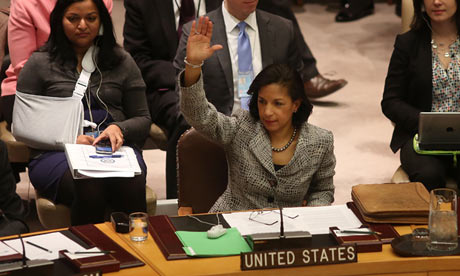
Susan Rice North Korea sanctions
UN ambassador Susan Rice votes at a security council meeting on imposing a fourth round of sanctions against North Korea. Photograph: Spencer Platt/Getty Images

The United Nations security council has voted unanimously to punish North Korea for last month's nuclear test with a toughened sanctions regime, hours after Pyongyang threatened to unleash a pre-emptive nuclear strike on the United States.

Secretary general Ban Ki-moon, a former South Korean foreign minister, said the resolution "sent an unequivocal message to [the North] that the international community will not tolerate its pursuit of nuclear weapons".

The decision by the 15-member council followed lengthy negotiations between the United States and China, the North's main ally. Measures range from tightened financial restrictions to cargo inspections and an explicit ban on exports of yachts and racing cars to the North, but experts say the real issue is enforcement.

China's UN ambassador Li Baodong said Beijing, Pyongyang's main trading partner, wanted to see "full implementation" of the resolution.

Susan Rice, the US ambassador to the UN, told reporters that the measures would "bite hard". She added: "North Korea will achieve nothing by continued threats and provocations."

A foreign ministry spokesman in Pyongyang threatened to launch "pre-emptive nuclear strikes on the headquarters of the aggressors" because Washington was pushing to start a nuclear war against it, in a statement hours before the UN vote.

Experts do not believe the North has managed to produce a warhead small enough to be mounted on a missile that could reach the US. They also pointed out that the original Korean language version referred to "invaders" rather than merely the "aggressors" of the English translation.

Jennifer Lind, assistant professor of government at Dartmouth College in New Hampshire, said that while the statement was disturbing, "North Korea has a long history of bluster and issuing threats that of course it does not carry out, [such as] its long term threats of turning Seoul into a sea of fire."

Earlier this week the North threatened to cancel the 1953 armistice that ended the Korean War.

Thursday's resolution condemns the North's third nuclear test "in the strongest possible terms" as a flagrant breach of previous resolutions, which bar it from testing or using nuclear or ballistic missile technology and importing or exporting material for the programmes.

It aims to hinder those programmes but also targets the ruling elite. A ban on luxury exports was introduced in 2006, but countries could decide what fell under that rubric; this time, specific items are identified.

The resolution warns the North against further provocations and demands its return to the Nuclear Nonproliferation Treaty. But it also stresses the council's commitment "to a peaceful, diplomatic and political solution" and urges a resumption of six-party talks.

All countries are required to freeze financial transactions – including the transport of suitcases stuffed with cash – or services that could contribute to the North's nuclear or missile programmes. Public financial support for trade deals that could assist the programmes is outlawed.

Countries must expel agents working for blacklisted companies from the North. They must inspect aircraft or vessels with suspect cargo and deny entry to those that refuse inspection.

Hazel Smith, an expert on the North at Cranfield University, said the key question was how rigorously the US implemented financial sanctions, citing tough measures taken by Washington towards the end of the Bush administration.

"They did have a major effect; they also paralysed diplomacy. But there is no diplomacy happening now," she said.

Analysts suggest the immediate reaction of the North is likely to be further angry rhetoric and possibly another nuclear test, as Pyongyang hinted earlier. South Korean government sources cited by Seoul news agency Yonhap said on Wednesday that the North had imposed no-fly and no-sail zones off its coasts, apparently preparing for military drills.

"North Korea will throw their usual histrionics about the resolution," said Andrei Lankov of Kookmin University in Seoul in an interview prior to the latest threat.

"Every time there's an escalation the risk of confrontation increases. But neither side wants anything to happen."

At a Senate foreign relations committee hearing on North Korea, chairman Robert Menendez described the nuclear strike threat as "absurd and suicidal".

Menendez, a Democrat, was holding the hearing as the UN security council voted for the resolution. He welcomed the new sanctions but said the US needed to do more to combine sanctions and military countermeasures with strong and realistic diplomacy aimed at North Korea and China.

"There should be no doubt about our determination, willingness, and capability to neutralise and counter any threat that North Korea may present," Menendez said. "I do not think the regime in Pyongyang wants to commit suicide, but that, as they must surely know, would be the result of any attack on the United States."

Glyn Davies, the State Department's special representative on North Korea, warned of "costly consequences" for the country.

Its 12 February nuclear test, he said, represented "an even bolder threat to US national security, the stability of the region and the global non-proliferation regime".

Davies told the committee the Pentagon was working with its counterparts in Japan and South Korea to ensure protection against an attack.

The US would continue to look at unilateral sanctions against banks and other North Korean-linked bodies and seek to harmonise existing sanctions with other countries, he added.

The US will not engage in negotiations unless there is a fundamental change in attitudes in North Korea. "The DPRK leadership must choose between provocation or peace, isolation or integration," Davies said.

Thousands Line Up for Last Glimpse of Chávez - New York Times

Posted: 07 Mar 2013 09:08 AM PST

CARACAS, Venezuela — Thousands of people waited for hours on Thursday to pay a moment of respect to the body of the late president of Venezuela, Hugo Chávez, dressed in his iconic red beret and green military uniform, visible to his people one last time.

The lines, steeped in loyalty and grief, started on Wednesday and stretched through the night at a military academy Mr. Chávez once attended, where he will lie in state until his funeral on Friday.

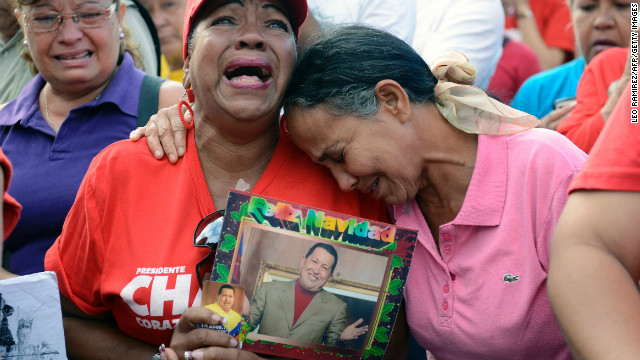
Many saluted the president's remains. Others crossed themselves. Government television broadcast the endless passage of mourners. One elderly woman beat her breast and nearly fainted. Parents and guards in dark suits picked up small children to give them a look.

"He had his beret on, his red beret, and he looked as if he were sleeping," said Luis Cabrera Aguirre, a retired rear admiral who served as an adviser to Mr. Chávez and was among the first group of officials permitted access.

He said that Mr. Chávez's head and torso were visible through a panel of glass at the coffin's upper half. The closed lower half was draped with the Venezuelan flag. Admiral Cabrera Aguirre said that Mr. Chávez's face and especially his neck appeared a little swollen or puffy, but that otherwise, "he looked just like he did in life."

Mr. Chávez, who was nearly omnipresent here in his 14-year rule, was not seen in Venezuela since leaving for Cuba for his fourth and last cancer surgery on Dec. 11. Even after the announcement of his return, in a pre-dawn flight on Feb. 18, he remained out of sight, while officials said he continued treatment at a Caracas military hospital. His death was announced Tuesday afternoon. He was 58 years old.

Conflicting accounts of his final days were beginning to emerge.

On Thursday, the Reuters news agency reported that a government source said that Mr. Chávez's health deteriorated rapidly after he held a bedside meeting with government ministers over the weekend. The source said that, with the cancer having spread to his lungs, Mr. Chávez had fallen into a coma on Monday, and that he died the next day of respiratory failure.

However, the head of Venezuela's presidential guard, Gen. José Ornella, told The Associated Press late Wednesday that Mr. Chávez died of a major heart attack.

General Ornella said that he was with Mr. Chávez at the moment of his death, and that among his final words were, "I don't want to die. Please don't let me die," the general said, adding, "because he loved his country, he sacrificed himself for his country."

"He couldn't speak, but he said it with his lips," General Ornella said.

Over his final weeks of seclusion, the opposition clamored for Mr. Chávez to make an appearance, and even some of his supporters began to question why he was unable to show himself.

On Thursday, lying in state, Mr. Chávez was finally reunited with his people once more.

Despite a rocky economic record and strings of broken or half-filled promises during his 14 years in office, the fundamental legacy of Mr. Chávez was intangible: he has changed the way Venezuelans think about themselves and their country.

Just as they did on Thursday, when people lined up for one last glimpse of their leader, enormous crowds thronged the streets on Wednesday to watch Mr. Chávez's modest brown wood coffin, covered in a Venezuelan flag, being carried through the capital, Caracas.

As it wound its way from the hospital where he died to the military academy where he studied as a young, unheralded cadet, hundreds of thousands of mourners — many dressed in his movement's characteristic red shirt — chanted, cried, tossed flowers or held up cellphones to photograph the coffin as it passed.

The procession on Wednesday stretched for miles, a river of red with drivers and motorcyclists trailing behind in an impromptu cortege.

"Chávez opened our eyes," said Carlos Pérez, 58, a cookie salesman who drove into town with his wife and took part in the caravan. "We used to be stepped on. We felt humiliated."

Conditions for the poor have certainly improved over the last decade and a half, and the ranks of the poor have shrunk. Government programs have given poor people access to low-cost food and free health care and have knocked down barriers to higher education, though many of those programs are plagued by inefficiencies and long waits.

Mr. Chávez mined and deepened the divide between the masses of Venezuela's poor and the middle and upper classes, presiding over a bitterly divided country. He mercilessly taunted and insulted those who disagreed with him, calling them fascists, good-for-nothings, traitors, oligarchs, reactionaries and puppets of the United States.

And he warned ceaselessly of enemies, inside and outside the country, who he said were poised to take away from the poor the benefits they had received under his government.

According to the Constitution, a new presidential vote must be called within 30 days. The vice president, Nicolás Maduro, 50, became the acting president, and already he appears likely to face a Chávez rival who had put in a strong performance in previous polls.

Reuters quoted opposition sources as saying on Wednesday that they have agreed to back Henrique Capriles, 40, the centrist governor of Miranda State who garnered 44 percent of the vote but lost to Mr. Chávez in last year's election.

William Neuman reported from Caracas, and Christine Hauser from New York.

Kredit: www.nst.com.my

Rabu, 6 Mac 2013

NST Online Business Times : latest

0 ulasan
Klik GAMBAR Dibawah Untuk Lebih Info
Sumber Asal Berita :-

NST Online Business Times : latest


Ringgit opens lower against US dollar

Posted: 06 Mar 2013 06:27 PM PST

The ringgit opened lower against the US dollar in early trade today, dealers said.

The ringgit was quoted at 3.1090/1125 to a US dollar against 3.1050/1070 yesterday.

The dealers said this was in line with the strengthening of the greenback, driven by the overnight rally in US stocks and an improved outlook in the American jobs market.

The local currency was higher against the Singapore dollar at 2.4888/4920 from 2.4944/4962 yesterday, and rose against the yen at 3.3053/3105 from 3.3230/3269 previously.

It rose against the British sterling to 4.6610/6669 from 4.6895/6934 on Wednesday and was higher against the euro at 4.0358/0413 from 4.0533/0568.-- Bernama

Short-term rates to remain stable

Posted: 06 Mar 2013 06:30 PM PST

Short-term rates are expected to remain stable Wednesday, with Bank Negara Malaysia intervening to absorb excess liquidity from the financial system, dealers said.

The central bank estimated today's surplus at RM26.396 billion in the conventional system and RM6.825 billion in Islamic funds.

Bank Negara will call for four conventional tenders of RM1 billion for seven days, RM1 billion for 14 days, RM1 billion for 21 days and RM1 billion for 32 days.

It will also conduct a repo tender for RM200 million for 92 days.

The central bank will call for four Al-Wadiah tenders for RM1.4 billion for seven days, RM800 million for 14 days, RM1.4 billion for 21 days and RM1.2 billion for 28 days.

The central bank will conduct a Commodity Murabahah Programme of RM100 million for 26 days.

At 4pm, the central bank will conduct an up to RM22.3 billion conventional overnight tender and RM2.5 billion Al-Wadiah overnight tender.-- Bernama

Kredit: www.nst.com.my

NST Online Top Stories - Google News

0 ulasan
Klik GAMBAR Dibawah Untuk Lebih Info
Sumber Asal Berita :-

NST Online Top Stories - Google News


Venezuelans line streets for Chavez - CNN

Posted: 06 Mar 2013 09:12 AM PST

Supporters of the late Venezuelan President Hugo Chavez cry in Caracas, a day after his death on March 6, 2013.
STORY HIGHLIGHTS
  • Hugo Chavez's casket is seen for the first time
  • The casket is moved in a procession from a hospital to a military academy
  • Thousands of Venezuelans were in the streets to watch the procession

Share your thoughts on Hugo Chavez.

(CNN) -- The political outcome in the wake of Venezuelan President Hugo Chavez's death remains uncertain, but in plazas across the country Wednesday, his followers made it clear they support a continuation of his policies.

Chavez put social programs at the center of his government, and his most fervent supporters credit him with providing their livelihood.

"Chavez gave us everything," one mourner said on state-run television.

Opinion: Chavez empowered the poor, divided a nation

A new election will be held within 30 days, possibly signaling a new path for the oil-rich nation.

Thousands of Venezuelans lined the streets of the capital Wednesday morning as Chavez's remains were taken from the military hospital where he died to the Fuerte Tiuna Military Academy in Caracas.

Chavez's simple wooden casket, draped in the Venezuelan flag, was held by soldiers as a priest recited a prayer and blessing on the late president. The casket was placed on top of a hearse decorated with flowers and wreaths, which slowly made its way toward the military academy.

The streets were a sea of green and red, as soldiers and red-clad supporters followed the procession.

Venezuela's interim leader thrust into spotlight

Some wept as the casket passed by, while others stretched out their arms to take pictures with their phones.

Presidents arrived in the country for the funeral, including Uruguay's Jose Mujica, Argentina's Cristina Kirchner and Bolivia's Evo Morales.

The country has declared seven days of mourning, closed schools for the rest of the week and deployed armed forces to "guarantee peace."

CNN iReport: Share your thoughts on Hugo Chavez

It was the Chavez faithful who were out in force Wednesday, but there remains a sizable and strong opposition to the ruling party.

One man said he fled Venezuela as a teenager because there was no future there under Chavez.

"I left Venezuela because my brother got kidnapped, our house got burglarized, cars stolen," Carlos Quijada said. "My parents had an import business and the currency controls made it impossible for them to import anything anymore."

Quijada says he has hope that things will improve with Chavez's absence.

"My life was completely altered because of that man. And I will not hide the fact that I am happy that he is no longer alive," he said.

Another Venezuelan, a music teacher named Juan Francisco who splits his time between his home country and Europe, says he does not rejoice at Chavez's death but has a number of reasons why he won't miss him.

Chavez was hypocritical on many key issues such as democracy and security, he wrote in a CNN iReport.

Vice President Nicolas Maduro, the interim president, has made no mention of running for election, but he is widely expected to be the United Socialist Party of Venezuela's candidate for the job.

During Chavez's absence from the political stage over the past three months, Maduro has been front and center. He has spoken at political rallies around the country and delivered updates about the president on national television, drawing growing support from Chavez loyalists.

U.S. reaction to Chavez's death: from mourning to celebration

Opposition critics said he was campaigning for office -- a claim the government denied. Even as it was announced that Maduro would temporarily assume the presidency, some questioned whether that was constitutional, since Chavez missed his inauguration and was never officially sworn in.

Opposition politicians haven't said who will represent them in the election. But as speculation mounted about Chavez's health in recent weeks, many had turned to Henrique Capriles, who lost to Chavez in October's presidential contest.

On Tuesday, Capriles called for a national dialogue including all Venezuelans, not just Chavez's supporters.

"Today there are thousands, maybe millions, of Venezuelans who are asking themselves what will happen, who feel anxiety, and including those who feel afraid," Capriles said.

CNN's Catherine E. Shoichet and Dana Ford contributed to this report.

UPDATE 2-Obama to meet with Republican senators over budget - Reuters

Posted: 06 Mar 2013 09:28 AM PST

Wed Mar 6, 2013 12:23pm EST

By Richard Cowan

(Reuters) - U.S. President Barack Obama plans to meet with several Republican senators for dinner on Wednesday as part of his effort to revive talks to tackle the nation's long-term deficit, the White House said.

The Democratic president is trying to cobble together what he calls a "common sense caucus" among lawmakers to help resolve U.S. budget woes and push his legislative agenda.

He also is scheduled to travel to Capitol Hill next week, when he will address Senate Republicans at a lunch on March 14.

Senate Republican leader Mitch McConnell said the lunch will be an opportunity to discuss budget and economic issues.

A source, who asked not to be identified, said Obama also plans to meet with House of Representatives Democrats next week, although the date has not yet been set.

Wednesday's dinner meeting, to be held at a hotel near the White House, could be postponed, the White House said, as Washington faced heavy snow forecasts that already had closed most federal agencies.

In recent days, Obama has searched for common ground with senators who in the past have indicated a willingness to compromise on budget issues. The White House on Sunday suggested talks could center around a broad budget deal that includes new tax revenues as well as reforms to entitlement programs. These include the Medicare health care program for the elderly and disabled and Social Security retirement benefits - programs that are rapidly growing in cost as the population ages.

The Republican U.S. senators Obama has contacted recently include Bob Corker of Tennessee, Tom Coburn of Oklahoma, Rob Portman of Ohio and Susan Collins of Maine, according to the senators or congressional aides. The White House declined to confirm the names.

Coburn will attend Wednesday's dinner, as will Senator John Hoeven of North Dakota, their aides said. Senator John McCain of Arizona, who ran unsuccessfully for president against Obama in 2008, also will attend, according to an aide. The New York Times said about 12 senators would attend.

At the heart of the U.S. fiscal crisis is disagreement over how to rein in the $16.7 trillion debt. Obama wants to narrow the fiscal gap with spending cuts and tax hikes. Republicans do not want to concede again on taxes after doing so in negotiations over the "fiscal cliff" at the New Year.

Last Friday marked the start of $85 billion in across-the-board budget cuts that are to be carried out by Sept. 30. It was not clear whether Obama, in his new contacts with Republican senators, was still trying to negotiate a substitute for those cuts.

Republican leaders rejected higher taxes as part of a budget deal that would have avoided the cuts contained in the so-called sequester that kicked in Friday.

Lawmakers are working short-term to avoid a government shutdown when the current U.S. federal budget expires at the end of March. Bills moving through the House and Senate will incorporate the $85 billion in lower spending.

Kredit: www.nst.com.my

Selasa, 5 Mac 2013

NST Online Business Times : latest

0 ulasan
Klik GAMBAR Dibawah Untuk Lebih Info
Sumber Asal Berita :-

NST Online Business Times : latest


MAS to start A330-300 KL-Sydney service

Posted: 05 Mar 2013 06:28 PM PST

MELBOURNE: Malayisia Airlines (MAS) will begin A330-300 services on its Sydney-Kuala Lumpur route from tomorrow.

The 283-seater aircraft services from Sydney replaces the evening B777-200 departures and will be double daily from April 1, MAS said in a statement.

The MH140 flight departs Sydney daily at 9.55pm and will arrive in Kuala Lumpur at 3.20am the following day, while from April 1, flight MH122, the second daily A330-300 service departs Sydney at 3.40pm and will arrive in Kuala Lumpur the same day at 8.50pm.

The return flight, MH141, will leave Kuala Lumpur daily at 9am to arrive in Sydney at 7.55pm, while the MH123 daily service departs Kuala Lumpur at 10.50pm and will arrive in Sydney at 9.45am the following day.

"The introduction of this new aircraft will reinforce MAS' position in the Australasian market, giving customers the opportunity to experience the latest state-of-the-art product, coupled with our award-winning hospitality," the nationsl carrier said.

MAS operates 51 weekly flights from Australian cities to Malaysia -- Sydney and Melbourne, both 14 flights each, Perth (11 flights), Adelaide (seven flights) and Brisbane (five flights).-- Bernama

Short-term rates to remain stable

Posted: 05 Mar 2013 06:06 PM PST

Short-term rates are expected to remain stable Wednesday, with Bank Negara Malaysia intervening to absorb excess liquidity from the financial system, dealers said.

The central bank estimated today's surplus at RM30.532 billion in the conventional system and RM7.725 billion in Islamic funds.

Bank Negara will call for a conventional tender for RM6 billion for five to 92 days. It will also conduct a repo tender for RM300 million for 92 days.

The central bank will call for four Al-Wadiah tenders for RM500 million for seven days, RM500 million for 14 days, RM700 million for 21 days and RM1.7 billion for 28 days.

At 4pm, the central bank will call for a conventional overnight tender for up to RM24.5 billion and a RM4 billion Al-Wadiah overnight tender.-- Bernama
Kredit: www.nst.com.my

NST Online Top Stories - Google News

0 ulasan
Klik GAMBAR Dibawah Untuk Lebih Info
Sumber Asal Berita :-

NST Online Top Stories - Google News


Dow passes intraday trading record; markets seem undaunted by Washington ... - Washington Post

Posted: 05 Mar 2013 09:18 AM PST

By noon Tuesday, the Dow was up more than 145 points, or 1.03 percent, to 14,273.70, blowing past both an intraday record and a closing record that were both set in October 2007, during a time when the economy was just peaking and headed toward disaster. The previous intraday-trading high was 14,198.10; the closing record was 14,164.53.

A little more than five years later, the crisis seems a distant memory for a number of big U.S. companies that are reporting record profits, even though many Americans remain jobless and wages have stagnated.

The country's most famous index tracks the stock prices of 30 companies, including such iconic firms as IBM, General Electric and JPMorgan, and it is weighted by price.

IBM, which carries by far the most weight in the Dow Jones index, has risen more than 80 percent in the last five years. Even a company like Hewlett-Packard, which also is on the index and has struggled to find its footing in recent years, has seen its shares jump more than 40 percent so far this year.

The Standard & Poor's 500-stock index, another oft-cited measure for the market, was also heading toward its record high Tuesday morning, jumping about 15 points, or 1.02 percent, to 1,540.69.

Tuesday's market gains came as the Chinese government announced overnight it was maintaining a growth target of 7.5 percent for this year. The government said it plans to increase spending to support the country's economy after a slip in growth last year.

The Dow's record high confirmed that the ongoing political paralysis in Washington has failed to spook the markets much in the past year. As lawmakers and President Obama lurch from one fiscal deadline to the next — from the debt-ceiling crisis in 2011 to the fiscal cliff to the steep budget cuts triggered last week — the markets have soldiered on with hardly a bump.

"The stock market and the American public are looking at the political theater with a jaundiced eye," said Ted Weisberg from the New York Stock Exchange, where he has been a trader on the floor for more than four decades.

The markets hardly reacted on March 1, when severe domestic and defense cuts went into effect. The Dow Jones Industrial even rose 0.25 percent that day. A popular index for gauging fear in the markets called the CBOE Volatility Index, or the VIX, dropped nearly one percent.

Wall Street's reactions have developed into a pattern of near-indifference followed by optimism when a political resolution is found.

In the days building up to the fiscal cliff at the end of last year, the markets were sanguine. But when a compromise was reached on New Year's Day, the Dow surged more than 308 points, or 2.35 percent. The S&P 500 jumped 36.25 points, or 2.54 percent.

Many on Wall Street feel they've seen this movie before, even dismissing the dire warnings of politicians as all theater.

"My sense is that our president and the White House are crying wolf," Weisberg said of President Obama's warnings about the sequester last week.

Yu-Dee Chang, chief trader at Ace Investment Strategists in Vienna, Va., said the impact of the sequester is being felt more strongly in Washington than on Wall Street. Investors have been less worried about the cuts themselves, which may be dramatic but still represent a tiny sliver of the national deficit.

Chang also noted that stock prices have been boosted by the Federal Reserve's massive stimulus program that has pushed down both long- and short-term interest rates. The low rates have encouraged investors to seek out higher returns in the stock market.

"The market has the Fed behind its back," Chang said. "Everyone is still looking for that yield. . . That's why the Fed strategy is working." 

Adjusted for inflation, the Dow is still about 10 percent off the 2007 high. Nevertheless, the market still has shown a remarkable turnaround since the crisis, at least compared to other measures like the country's economic growth and joblessness figures.

People eyeing their retirement portfolios may be cheering the market's return to pre-recession levels. But how much longer can the good times last?

Ed Easterling, founder and president of investment firm Crestmont Holdings, says that stocks are at a point that's "about as good as they can get, absent a bubble."

"It's time to be careful," he said.

Staff writer Ylan Q. Mui contributed to this report.

1000 flights canceled as storm takes aim at Chicago - Chicago Tribune

Posted: 05 Mar 2013 09:12 AM PST

WGN-TV's Tom Skilling updates his forecast on today's snowstorm.

More than 1,000 flights have been canceled in Chicago as a fierce winter storm threatens to dump as much as 10 inches of wind-whipped snow in time for the evening commute.

Airlines at O'Hare International Airport have canceled more than 850 flights because of the storm but are so far not reporting significant delays, according to the Aviation Department. More than 230 flights have been canceled at Midway Airport, and Southwest Airlines has cancelled all of its flights there between 10 a.m. and 5 p.m.

Metra has canceled one afternoon train on its Metra Electric District Line -- Train No. 737 scheduled to leave Chicago at 5:20 p.m. and arrive in Flossmoor at 6:01 p.m. Passengers can take the 5:23 p.m. train No. 757, which will make extra stops between Hazel Crest and Flossmoor.

Dozens of schools are also closed today or are planning to close early. Check here for list.

Forecasters are predicting 4 to 8 inches will fall on the Chicago area by tonight, with 10 inches possible in some areas, according to the National Weather Service. An inch or more per hour is expected at the height of the storm this afternoon and evening. Already, between 7:30 a.m. and 8:30 a.m., 1½ inches of snow fell in DeKalb, with an inch falling in Elburn in the 90 minutes before 7:42 a.m., according to the National Weather Service.

National Weather Service meteorologist Andrew Krein said the city is expected to receive 6 to 8 inches from today's storm. Heavier pockets of snowfall — around 10 inches — could hit parts of the suburbs, he said.

Krein said O'Hare International Airport only received trace snowfall — or less than one-tenth of an inch — from midnight to 6 a.m. The National Weather service will take the next snowfall measurement at noon, he said.

"The whole area's going to be hit pretty hard," predicted Richard Castro, a meteorologist with the weather service in Romeoville.

Light snow started to fall in the area shortly before daybreak but state police said roads were generally clear. Snow is expected to begin accumulating at the tail end of the morning rush hour, said Ben Deubelbeiss, another meteorologist in Romeoville. "It'll probably start to get bad around 10," he said.

The weather service has issued a winter storm warning for the region from 9 p.m. through midnight. Originally, the warning was to go into effect at 3 a.m., but its approach has been slower than expected.

By the afternoon, the storm will get intense with high winds and snow falling at an inch and a half per hour at times, making it difficult for snowplows to keep up.

The Chicago Department of Streets and Sanitation dispatched its fleet of more than 280 trucks early this morning to begin salting and clearing the city's main streets.

Crews have removed median barriers on Lake Shore Drive, just north of Oak Street, according to Peter Scales, spokesman for the Chicago Department of Transportation. "When a storm of this magnitude is approaching, it is now standard protocol to remove the barriers before the storm hits, to make certain the access points are available before the snow starts to fall," Scales wrote in an email.

The Illinois Tollway has activated its fleet of 182 snowplows.

Tuesday's snow totals could be just enough to turn around an otherwise dry winter.

Amy Seeley, another weather service meteorologist, said it's unlikely the maximum amount would fall at O'Hare International Airport, where the weather service takes official measurements. But if it did, the 10 inches would bump this winter's snowfall a tenth of an inch above the season-to-date average. "It would put us right there," Seeley said, noting she's still expecting closer to 7 or 8 inches at O'Hare.

Though the city has seen its share of snow in 2013, it's still behind yearly averages for this time of year, Krein said. At the end-of-day Monday, O'Hare had measured 19.8 inches of snowfall for the 2012-2013 snow season, he said. The average for this time of year is 30.5 inches.

The largest snowfall measured this season at O'Hare was 4.8 inches on Feb. 26, Krein said.

We may be behind in snowfall, but precipitation levels are high, Krein said. Since Jan. 1, O'Hare has measured 6.61 inches of precipitation, almost doubling the average of 3.83 inches for this time of year.

"Our precipitation levels are above normal because of heavier rains that came in large chunks over a few days," Krein said. "We're definitely well below average snowfall but our actual precipitation levels are 2.78 inches above normal."

Kredit: www.nst.com.my

Isnin, 4 Mac 2013

NST Online Business Times : latest

0 ulasan
Klik GAMBAR Dibawah Untuk Lebih Info
Sumber Asal Berita :-

NST Online Business Times : latest


MAS in India offers up to 30pc discount

Posted: 04 Mar 2013 06:21 PM PST

NEW DELHI: Malaysia Airlines is back with its mega air fare sale by offering up to 30 per cent discount for Indian travellers to various destinations in Malaysia like Kuala Lumpur and beyond, such as Australia and New Zealand, Hong Kong and Singapore.

The deal offered through www.malaysiaairlines.com is valid for booking up to March 15, 2013 and travel from now until September 30, 2013 from Delhi, Mumbai, Hyderabad, Bangalore and Chennai.

"India is one of the most significant source markets and this is the reason Malaysia Airlines keeps on introducing value added services for avid Indian travellers," Malaysia Airlines Regional
Senior Vice President, South Asia & Middle East Azahar Hamid said in a statement.

He said this offer is for price-conscious Indian consumers looking for value deals to great holiday destinations.


"When the domestic fares are at an all-time high we proudly offer the best for some of the most sought after international destinations like Australia, New Zealand, Thailand and ndonesia.

"We want more and more Indian passengers to experience our in-flight services like elaborate Indian cuisine and quality on-board entertainment like the latest blockbusters, popular TV shows, multi-player games and critically acclaimed album releases," he said.

An all-inclusive flight to Kuala Lumpur from Delhi is priced at Rs27,842 (RM1,556), from Mumbai Rs23,071 (RM1,289) and from Chennai Rs9,849 (RM550).

Fares to Sydney from Delhi are Rs48,190 (RM2,693), from Hyderabad Rs27,584 (RM1,542) and from Bengaluru Rs44,315 (RM2,476).

Malaysia Airlines is currently well connected between the five Indian metro cities of New Delhi, Bengaluru, Chennai, Mumbai and Hyderabad with its home base Kuala Lumpur.

It currently operates 54 weekly flights from India to Malaysia comprising New Delhi 12 flights), Mumbai (11 flights), Chennai (14 flights), Hyderabad (7 Flights) and Bangalore (10 flights).-- Bernama

KL shares open higher in early trade

Posted: 04 Mar 2013 05:58 PM PST

Share prices opened higher in early trade today with buying interest seen in most heavyweights led by Maybank, dealers said.

After 15 minutes of trading, the FBM KLCI rose 3.55 points to 1,639.53 after opening at 1,637.81.

HwangDBS Vickers Research Sdn Bhd said Wall Street was up last night with key equity indices rising between 0.3 per cent and 0.5 per cent amid optimisim that the Federal Reserve would continue to provide monetary stimulus.

The research house said the local bourse may however still continue its lacklustre performance.

"The benchmark index is expected to gyrate sideways with a negative bias ahead," it said in a research note here.

Meanwhile, the Plantation Index improved 19.35 points to 7,869.86, the Industrial Index added 2.5 points to 2,804.79 and the Finance Index jumped 46.65 points to 15,196.5.

The FBM Emas Index increased 23.53 points to 11,169.21, the FBMT100 advanced 23.12 points to 11,024.24, the FBM Mid 70 Index rose 22.359 points to 12,272.35 while the FBM Ace Index slipped 3.81 points to 3,952.41.

Gainers led losers by 107 to 51, with 87 counters unchanged, 1,398 untraded and 19 suspended.

Turnover stood at 57.928 million shares worth RM60.423 million.

Actives, Patimas edged up half a sen to six sen, IRM Group shed 2.5 sen to 8.5 sen while Compugates was unchanged at nine sen.

Heavyweights, Maybank gained six sen to RM9.11, Axiata Group added one sen to RM6.39 while Sime Darby was unchanged at RM9.19.-- Bernama

Kredit: www.nst.com.my

NST Online Top Stories - Google News

0 ulasan
Klik GAMBAR Dibawah Untuk Lebih Info
Sumber Asal Berita :-

NST Online Top Stories - Google News


At least 15 killed on Kenya coast on election day - Reuters

Posted: 04 Mar 2013 08:00 AM PST

REFILE - ADDING DATE A Masai woman walks out of a polling station after she casts her ballot papers during the presidential and parliamentary elections near town of Magadi some 85 km (53 miles) south of Nairobi March 4, 2013. REUTERS/Goran Tomasevic

NAIROBI/MOMBASA, Kenya | Mon Mar 4, 2013 11:39am EST

(Reuters) - At least 15 people were killed in attacks by machete-wielding gangs on Monday as millions of Kenyans voted in the first presidential election since a disputed 2007 poll unleashed weeks of tribal bloodshed.

Voting the tight contest passed off peacefully across most of the East African nation, although many of its 14.3 million voters were caught in long lines. Election officials said there was a high turnout without giving figures.

Officials and candidates have made impassioned appeals to avoid a repeat of the tribal rampages that erupted five years ago when disputes over the poll result fuelled clashes between tribal loyalists of rival candidates.

More than 1,200 people were killed, shattering Kenya's reputation as one of Africa's most stable democracies and bringing its economy, sub Saharan Africa's fourth-largest, to a standstill.

Just hours before voting began, at least nine security officers in the restive coastal region were hacked to death in two attacks, and six attackers were killed, regional police chief Aggrey Adoli said.

Senior police officers blamed the attacks on a separatist movement, suggesting different motives to those that caused the post-2007 vote ethnic killings that could limit their impact.

As in 2007, the race has come down to a high-stakes duel between two candidates, this time between Deputy Prime Minister Uhuru Kenyatta and Prime Minister Raila Odinga, the loser in 2007 to outgoing President Mwai Kibaki. Both contenders will depend heavily on votes from their tribes.

The United States and Western donors are worried about the stability of a nation that is an ally in the fight against militant Islam in the region.

They are also concerned about how to respond to a victory by Kenyatta, who faces charges by the International Criminal Court of orchestrating violence five years ago.

"If elected, we will be able to discharge our duties," said Kenyatta's running mate, William Ruto who also faces charges of crimes against humanity. "We shall cooperate with the court with a final intention of clearing our names."

Initial provisional results for the presidential race began trickling in moments after polls closed at 5 p.m. (1400 GMT), but it was too early to predict an outcome.

Many polling stations will close later because their opening was delayed and some still had long lines. The election commission has seven days to announce the official outcome. Polls suggest there could be a run-off, provisionally set for April.

VOTERS WARY

The European Union observer mission said turnout was high even at the coast where the attacks took place.

"The atmosphere observed is mostly calm," Alojz Peterle, chief of EU Observer Mission and former Slovenian prime minister, told reporters at a polling station in central Nairobi.

"People still queue peacefully and patiently. We hope that this peaceful and patience atmosphere will last until the end of the procedure even if it takes longer than expected."

One of the attacks on Monday took place on the outskirts of Mombasa and another in Kilifi about 50 km (80 miles) to the north. Senior police officers blamed them on a separatist movement, the Mombasa Republican Council (MRC), which wanted the national vote scrapped and a referendum on secession instead.

At the Kilifi site, Reuters footage showed a piece of paper on the ground with the words: "MRC. Coast is not Kenya. We don't want elections. We want our own country.

But the group's spokesman denied responsibility and said it only sought change by peaceful means.

Even before the violence, many Kenyans were wary, notably in hotspots last time. Some shopkeepers ran down stocks and some people in mixed tribal areas returned to their homelands. But broadly the vote passed off smoothly with most complaints related to the long wait or delayed opening of polling stations.

"Kenya is greater than any of us. Let the will of the people prevail to avert violence," said accountant George Omondi, 33, in Kisumu, a flashpoint city last time when violence flared after the 2007 result. "We have learnt from the past and should any of the contenders lose, they should accept the outcome."

Kenya's neighbors have been watching nervously, after their economies felt the shockwaves when violence five years ago shut down trade routes running through east Africa's biggest economy. Some landlocked states have stockpiled fuel and other materials.

Adding to tension, the al Shabaab Islamist militant group battling Kenyan peacekeeping troops in Somalia, urged Muslims to boycott the vote in Kenya and wage jihad against its military.

In Garissa, a largely Muslim town with a significant ethnic Somali population, two civilians were shot dead late on Sunday. A bomb blast in the Mandera area near the border wounded four. Officials did not say who were behind the incidents.

UNCERTAINTY

Voters were undeterred. In the early hours before voting, some Kenyans blew whistles and trumpet-like "vuvuzelas" to wake up voters, and queues formed hours before polls opened at 6 a.m.

"Our future is uncertain but we long for peace and victory is on our side this time round," said Odinga supporter 32-year-old Eunice Auma in Kisumu, where violence flared after 2007.

"However, should our candidate (Odinga) fail to clinch victory. I'm afraid violence will erupt," she said.

Kibaki, barred from seeking a third five-year term, made what he described as a "passionate plea" for a peaceful vote. All the candidates have vowed to accept the result.

Although the two leaders are well ahead of the other six contenders, polls suggest they will struggle to secure an outright win, which could make for a tense run-off. A narrow first-round victory for either could spark legal challenges.

To try to prevent a repeat of the contested outcome that sparked the violence after the December 2007 vote, a new, broadly respected election commission is using more technology to prevent fraud, speed up counting and increase transparency.

To build confidence, Kenya has passed a new constitution since 2007, police chiefs have deployed extra forces to maintain security and there is a more independent judiciary which commands greater respect. Officials have appealed to candidates to raise any challenges in the courts and not on the streets.

Even so, Odinga, 68, has lifted a warning flag, telling Reuters two days before the vote that the commission had by "design or omission" failed to register all voters in his strongholds, a charge the commission denies.

Alongside the presidential race, there are hotly contested elections for senators, county governors, members of parliament, women representatives in county assemblies and civic leaders.

(Additional reporting by Hezron Ochiel in Kisumu, Noor Ali in Isiolo, Drazen Jorgic, Beatrice Gachenge, Yara Bayoumy, George Obulutsa, Duncan Miriri in Nairobi; Writing by Edmund Blair; Editing by James Macharia; and Philippa Fletcher)

With the sequester, Obama gets his 'balanced' approach - Washington Post

Posted: 04 Mar 2013 07:56 AM PST

Obama continues to complain the sequester does not represent a balanced approach to deficit reduction, and wants to replace some of the spending cuts with tax increases. But the Simpson-Bowles Commission laid out what a "balanced" approach should entail: $3 of spending cuts for every $1 dollar in tax increases. Well according to Sen. Rob Portman (R-Ohio), by that standard Congress and the president have nearly met that mark.

Just a few weeks ago, as part of the fiscal-cliff deal, Congress approved $620 billion in tax hikes over ten years with no spending cuts. That means that to meet the 3-to-1 ratio, we should have a corresponding $1.86 trillion in spending cuts. But the sequester cuts just $1.72 trillion in spending over 10 years, according to Portman's office. That is a ratio of just 2.78-to-1. We would need to cut an additional $138 billion, Portman calculates, in order to meet the 3-to-1 ratio recommended by Simpson-Bowles.

If anything, the spending cuts Congress enacted in the sequester are not too deep — they are not deep enough.

There is nothing wrong with cutting $1.72 trillion from the federal budget. The problem with the sequester is that the cuts were not targeted — hitting vital programs (like national defense) and wasteful ones with equal force. For weeks, Obama tried to use the indiscriminate nature of the sequester to bludgeon Republicans into replacing some of the cuts with new tax revenues. But his dire warnings that criminals would be set free, teachers laid off, meat inspectors thrown off the job, air traffic controllers forced to abandon their posts backfired. It turned out most of his claims were exaggerated or flat untrue. And the false threats failed to deter Republicans from holding the line and demanding that the spending cuts be enacted in their entirety.

Now it appears Obama has backed down. After issuing apocalyptic warnings of the plagues and pestilence would descend upon the land if the sequester took effect, on Friday he declared, "This is not going to be [an] apocalypse, as some people have said." (Some people, Mr. President?) Instead of the end of the world, the sequester is now "just dumb."

Well the "dumbness" of the sequester can easily be fixed — and it looks like Obama and Congressional Republicans are going to do that. The New York Times reports that "the president and his Republican adversaries said they would not carry the fight over the cuts into a coming legislative effort to finance the government through Sept. 30, essentially declaring a cease-fire in the budget wars that have dominated Washington since 2011." Instead of using the threat of a government shut down on March 27 to force Republicans to replace the sequester with more spending and higher taxes, Obama has apparently agreed to sign a continuing resolution that locks in the sequester levels of spending and gives him flexibility to choose how and where to cut, so that vital programs are not adversely impacted.

What this means is that, by sticking to their guns in the sequester showdown, Republicans have actually forced Obama into the "balanced approach" he called for but did not actually pursue. We are now almost at the Simpson-Bowles 3-to-1 ratio. Unfortunately, Washington is not doing it in a way that promotes growth. The cuts come from discretionary programs, when it is entitlement spending that is driving our long-term debt and deficits. And the revenues come from raising tax rates on small businesses and the wealthy, rather than lowering tax rates, eliminating preferences and simplifying the tax code.

Still, keep in mind where Obama wanted to take the country. His original demand in the fiscal cliff negotiations last year was a $1.6 trillion tax paired with a $50 billion spending increase. Instead, a few months later, he got a $620 billion tax increase paired with a $1.72 trillion spending cut.

From a conservative standpoint, that may be less than ideal. But for a party that controls just one half of one branch of the federal government, it's not bad.

Read more from Marc Thiessen's archive, follow him on Twitter or subscribe to his updates on Facebook.

Kredit: www.nst.com.my
 

NST Online

Copyright 2010 All Rights Reserved